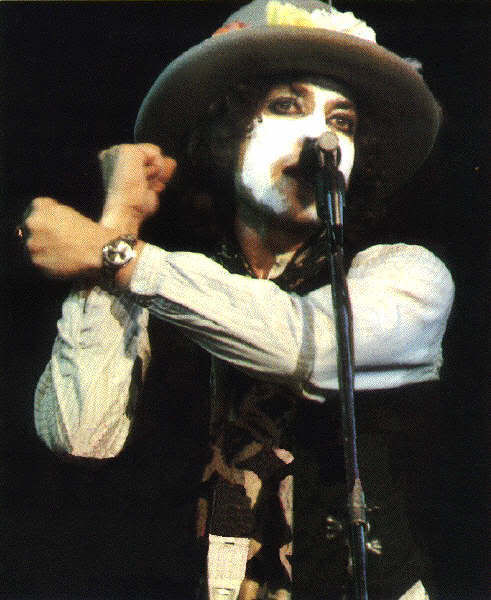
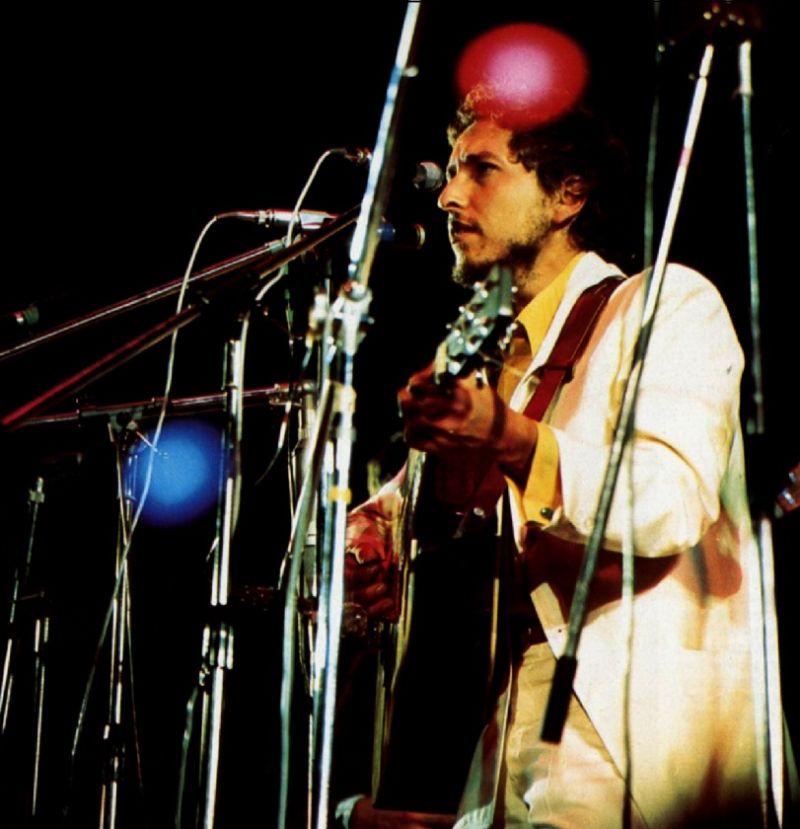
I married Isis on the fifth day of May
But I could not hold on to her very long
So I cut off my hair and I rode straight away
For the wild unknown country where I could not go wrong
One of his strongest performances on video….
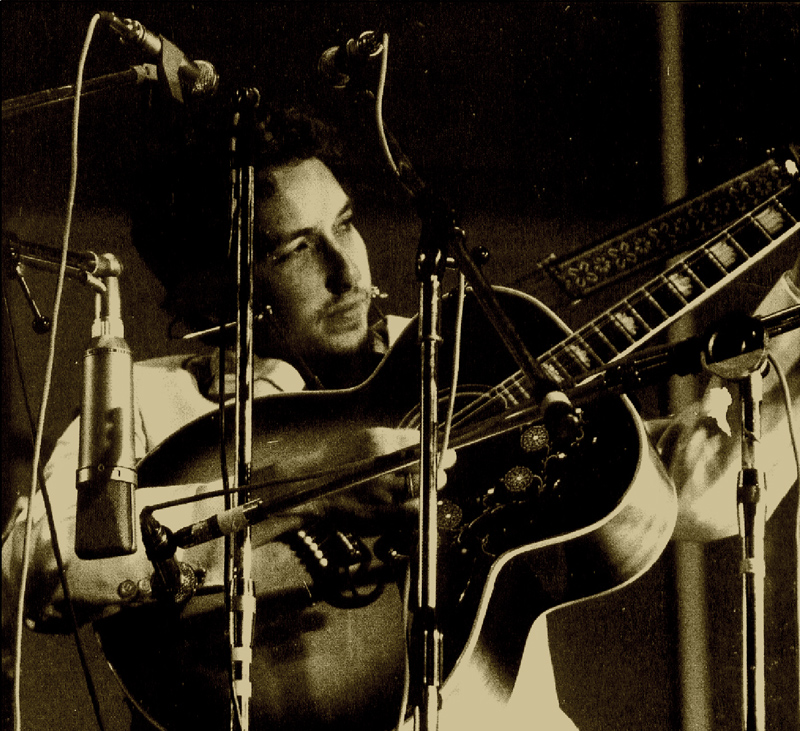
Forum de Montréal Montreal, Quebec, Canada 4 December 1975
Bob Dylan (vocal, guitar)
Bob Neuwirth (guitar)
Scarlet Rivera (violin)
T-bone J. Henry Burnett (guitar)
Roger McGuinn (guitar)
Steven Soles (guitar)
Mick Ronson (guitar)
David Mansfield (steel guitar, violin, mandolin ,dobro)
Rob Stoner (bass, vocals)
Howie Wyeth (piano, drums)
Luther Rix (drums, percussion)
Ronee Blakley (vocal)
I came to a high place of darkness and light
The dividing line ran through the center of town
I hitched up my pony to a post on the right
Went in to a laundry to wash my clothes down
A man in the corner approached me for a match
I knew right away he was not ordinary
He said, “Are you lookin’ for somethin’ easy to catch?”
I said, “I got no money.” He said, “That ain’t necessary”
We set out that night for the cold in the North
I gave him my blanket, he gave me his word
I said, “Where are we goin’?” He said we’d be back by the fourth
I said, “That’s the best news that I’ve ever heard”
I was thinkin’ about turquoise, I was thinkin’ about gold
I was thinkin’ about diamonds and the world’s biggest necklace
As we rode through the canyons, through the devilish cold
I was thinkin’ about Isis, how she thought I was so reckless
How she told me that one day we would meet up again
And things would be different the next time we wed
If I only could hang on and just be her friend
I still can’t remember all the best things she said
We came to the pyramids all embedded in ice
He said, “There’s a body I’m tryin’ to find
If I carry it out it’ll bring a good price”
’Twas then that I knew what he had on his mind
The wind it was howlin’ and the snow was outrageous
We chopped through the night and we chopped through the dawn
When he died I was hopin’ that it wasn’t contagious
But I made up my mind that I had to go on
I broke into the tomb, but the casket was empty
There was no jewels, no nothin’, I felt I’d been had
When I saw that my partner was just bein’ friendly
When I took up his offer I must-a been mad
I picked up his body and I dragged him inside
Threw him down in the hole and I put back the cover
I said a quick prayer and I felt satisfied
Then I rode back to find Isis just to tell her I love her
She was there in the meadow where the creek used to rise
Blinded by sleep and in need of a bed
I came in from the East with the sun in my eyes
I cursed her one time then I rode on ahead
She said, “Where ya been?” I said, “No place special”
She said, “You look different.” I said, “Well, not quite”
She said, “You been gone.” I said, “That’s only natural”
She said, “You gonna stay?” I said, “Yeah, I jes might”
Isis, oh, Isis, you mystical child
What drives me to you is what drives me insane
I still can remember the way that you smiled
On the fifth day of May in the drizzlin’ rain
“We are all just monkeys with money and guns.”
~Tom Waits
If you get far enough away you’ll be on your way back home.
~Tom Waiys – “Blind Love”
Tango till they’re sore @ Letterman 1986 + interview:
From Wikipedia:
Released
30 September 1985
Recorded
RCA Studios
Genre
Rock, experimental rock
Length
53:46
Label
Island
Producer
Tom Waits
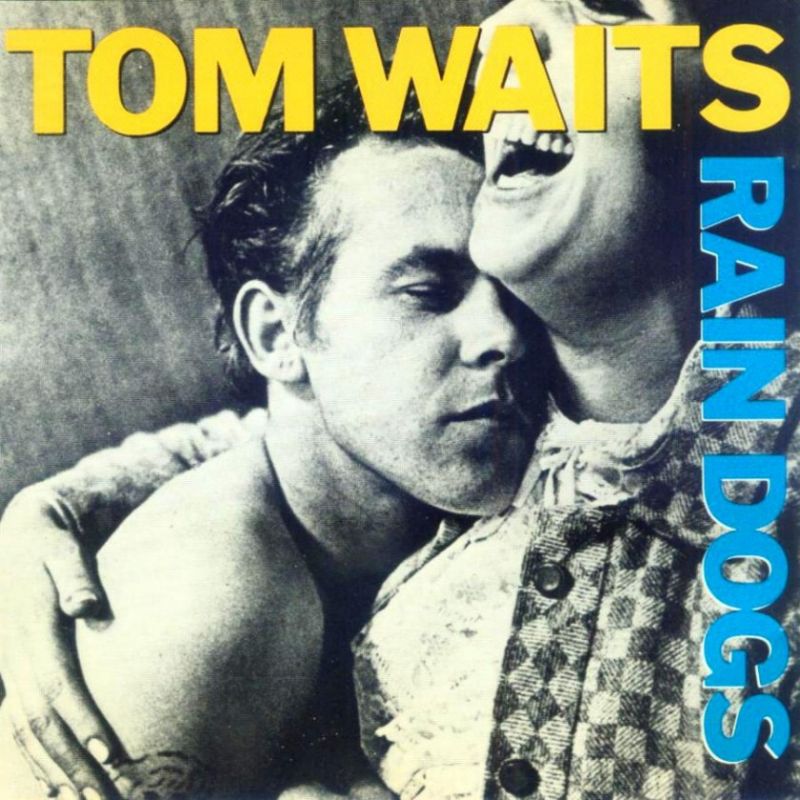
Rain Dogs is the 9th album by American singer-songwriter Tom Waits, released in September 1985 on Island Records.A loose concept album about “the urban dispossessed” of New York City, Rain Dogs is generally considered the middle album of a trilogy that includes Swordfishtrombones and Franks Wild Years.
The album, which includes appearances by guitarists Keith Richards and Marc Ribot, is noted for its broad spectrum of musical styles and genres, described by Rolling Stone as merging “Kurt Weill, pre-rock integrity from old dirty blues, [and] the elegiac melancholy of New Orleans funeral brass, into a singularly idiosyncratic American style.”
The album peaked at #29 on the UK charts and #188 on the US Billboard Top 200. In 1989, it was ranked #21 on the Rolling Stone list of the “100 greatest albums of the 1980s.” In 2003, the album was ranked number 397 on the magazine’s list of “The 500 Greatest Albums of All Time”.
Pitchfork Media listed Rain Dogs as 8th best album of the 1980s. Slant Magazine listed the album at #14 on its list of “Best Albums of the 1980’s”.
Reception:
With its jarring rhythms and unusual instrumentation — marimba, accordion, various percussion — as well as its frequently surreal lyrics, Rain Dogs is very much a follow-up to Swordfishtrombones, which is to say that it sounds for the most part like The Threepenny Opera being sung by Howlin’ Wolf. The chief musical difference is the introduction of guitarist Marc Ribot, who adds his noisy leads to the general cacophony. But Rain Dogs is sprawling where its predecessor had been focused: Tom Waits’ lyrics here sometimes are imaginative to the point of obscurity, seemingly chosen to fit the rhythms rather than for sense. In the course of 19 tracks and 54 minutes, Waits sometimes goes back to the more conventional music of his earlier records, which seems like a retreat, though such tracks as the catchy “Hang Down Your Head,” “Time,” and especially “Downtown Train” (frequently covered and finally turned into a Top Ten hit by Rod Stewart five years later) provide some relief as well as variety. ~William Ruhlmann (allmusic.com)
—
…..I can’t choose all three albums as my all-time favourite, so Rain Dogs – the best by a snout – clinches it. Waits had refreshed his sound on Swordfishtrombones two years earlier by moving beyond piano and guitar to dabble with a wider variety of instruments, and on Rain Dogs his repertoire continued to expand, with pump organs, accordions and bowed saws. He also gained the talents of guitarist Marc Ribot, whose humid Cuban licks on Jockey Full of Bourbon perfectly complement Waits’s suave dishevelment.The range of musical styles sprawled, too, and Rain Dogs contains cabaret numbers, country songs, gospel, polkas, ballads and sea shanties. Waits is a sucker for the theatrical, and the ragbag cast here is at the carnivalesque end of things, plus sad-eyed dames and a girl with tattooed tear – “one for every year he’s away, she said” – at the late-night, romantically downbeat, Edward Hopper-ish end. (Most of the album was written in a lower Manhattan basement.)
The album has been noted as one of the most important musically and critically in Waits’ career, in particular to the new direction which he undertook from 1983’s Swordfishtrombones onwards.
The album is notable for its many different musical styles; among the album’s 19 tracks are two instrumentals (“Midtown” and “Bride of Rain Dog”), a polka (“Cemetery Polka”), a “kind of a New Orleans thing with trombone” (“Tango Till They’re Sore”), ballads (“Time”), pop music (“Downtown Train”), and “a gospel thing” (“Anywhere I Lay My Head”). “Blind Love” marks Waits’ first fully-fledged attempt at the country genre. As Waits said on the Rain Dogs Island Promo Tape (which consisted of taped comments on songs as sent to radio stations, circa late 1985):
“Blind Love” is one of my first country songs. I like Merle Haggard. Most of those other guys, though, sound like they’re all just drinking tea and watching their waist and talking to their accountant. This one I think subscribes to some of that roadhouse feel.
The song “Hang Down Your Head” is loosely based on the folk song “Tom Dooley”, with the lyrics altered but the melody remaining mostly intact.
Rolling Stone called Rain Dogs Waits’ “finest portrait of the tragic kingdom of the streets.”The album’s title comes from an expression which suggests such an atmosphere. Waits cast further light on the metaphor by stating that the album was about “People who live outdoors. You know how after the rain you see all these dogs that seem lost, wandering around. The rain washes away all their scent, all their direction. So all the people on the album are knit together, by some corporeal way of sharing pain and discomfort.”
According to Barney Hoskyns, the album’s general theme of “the urban dispossessed” was inspired in part by Martin Bell’s 1984 documentary Streetwise, to which Waits had been asked to contribute music.
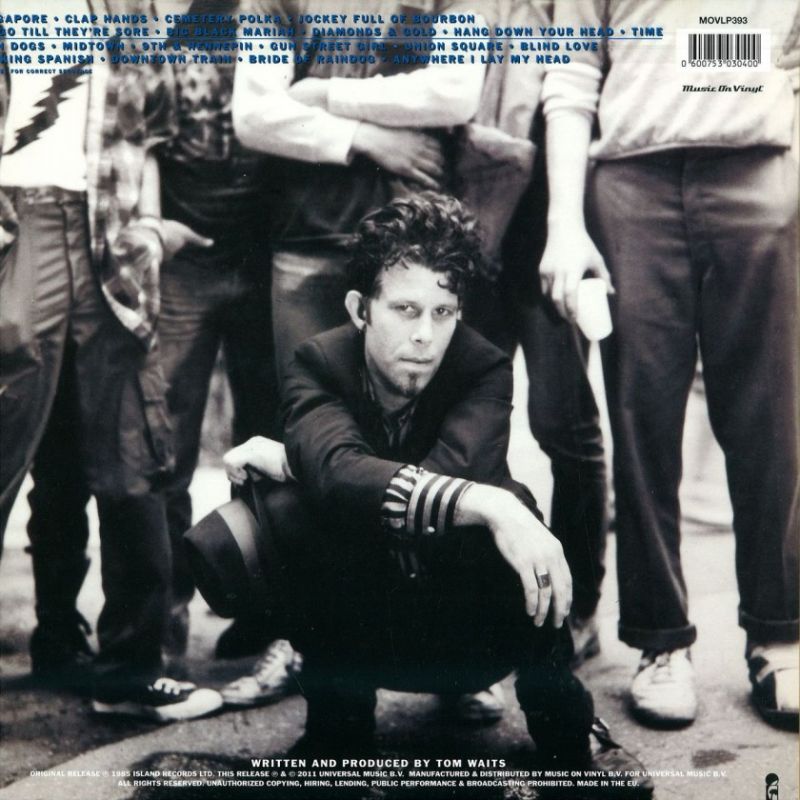
Track Listing:
“Singapore” 2:46
“Clap Hands” 3:47
“Cemetery Polka” 1:51
“Jockey Full of Bourbon” 2:45
“Tango Till They’re Sore” 2:49
“Big Black Mariah” 2:44
“Diamonds & Gold” 2:31
“Hang Down Your Head” Kathleen Brennan, Waits 2:32
“Time” 3:55
“Rain Dogs” 2:56
“Midtown” (instrumental) 1:00
“9th & Hennepin” 1:58
“Gun Street Girl” 4:37
“Union Square” 2:24
“Blind Love” 4:18
“Walking Spanish” 3:05
“Downtown Train” 3:53
“Bride of Rain Dog” (instrumental) 1:07
“Anywhere I Lay My Head”
Personnel:
Performer
Tom Waits – vocals (1–10, 12–17, 19), guitar (2, 4, 6, 8–10, 15–17), organ (3, 19), piano (5, 12), pump organ (8), harmonium (18), banjo (13)
Musicians
Tom Waits – vocals (1–10, 12–17, 19), guitar (2, 4, 6, 8–10, 15–17), organ (3, 19), piano (5, 12), pump organ (8), harmonium (18), banjo (13)
It can be explained in just one word: sincerity. When a hillbilly sings a crazy song, he feels crazy. When he sings, ‘I Laid My Mother Away,’ he sees her a-laying right there in the coffin. He sings more sincere than most entertainers because the hillbilly was raised rougher than most entertainers. You got to know a lot about hard work. You got to have smelt a lot of mule manure before you can sing like a hillbilly. The people that have been raised something like the way the hillbilly has…. knows what he sings about and appreciates it
~Hank Williams (on the success of Country Music)
Nobody had a talent for making suffering enjoyable like Hank Williams
~Kris Kristofferson
Hank Williams was the first influence I would think.
~Bob Dylan (to Billy James, Oct 1961)
I started writing songs after I heard Hank Williams.
~Bob Dylan (The Les Crane Show, 17 Feb 1965)
Cold Cold Heart:
From Wikipedia:
Birth name
Hiram King Williams
Also known as
The Lovesick Blues Boy
Lovesick
Luke the Drifter
Hank Williams, Sr.
The Hillbilly Shakespeare
Born
September 17, 1923
Mount Olive, Butler County, Alabama
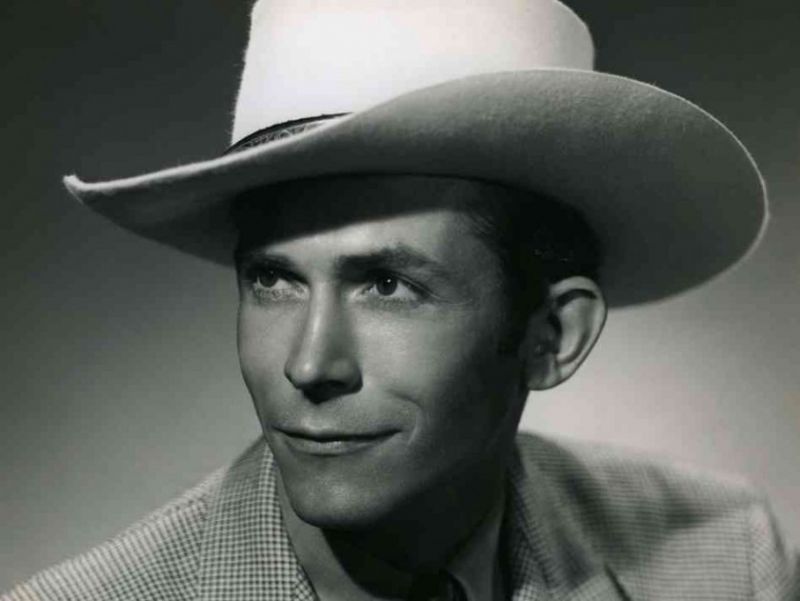
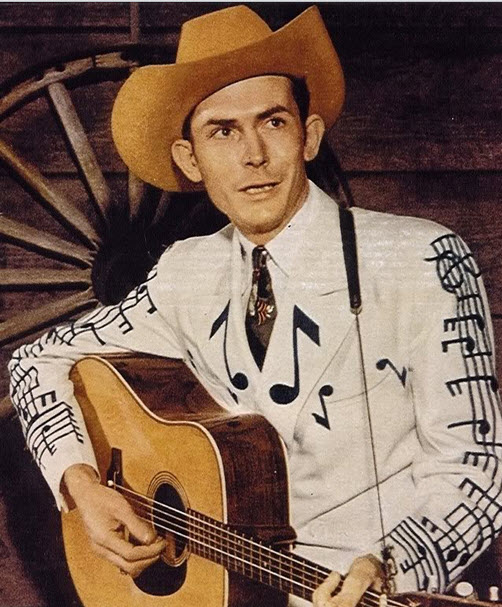
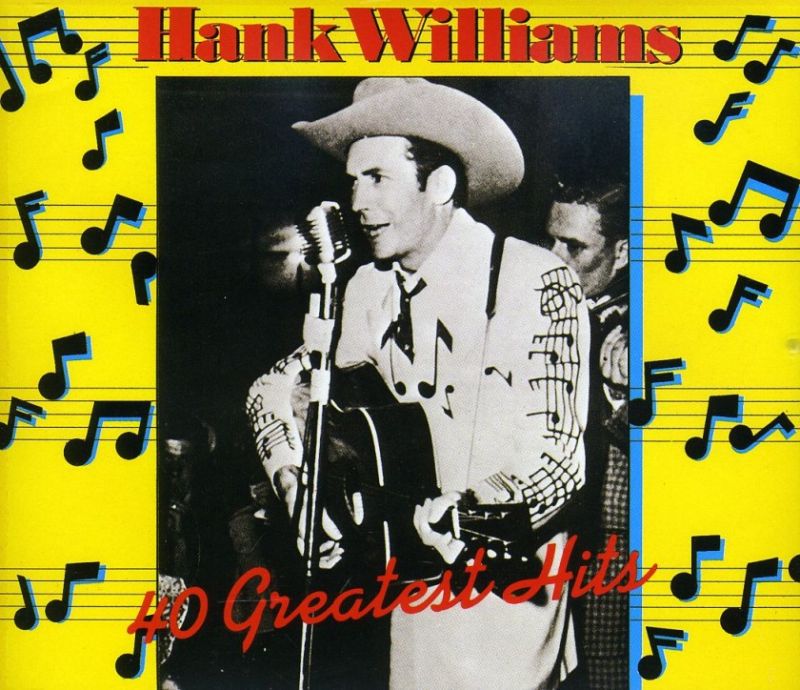
Hank Williams (September 17, 1923 – January 1, 1953), born Hiram King Williams, was an American singer-songwriter and musician regarded as one of the most important country music artists of all time. Williams recorded 35 singles (five released posthumously) that would place in the Top 10 of the Billboard Country & Western Best Sellers chart, including 11 that ranked number one.
From allmusic – Stephen Thomas Erlewine:
Hank Williams is the father of contemporary country music. He was a superstar by the age of 25; he was dead at the age of 29. In those four short years, he established the rules for all the country performers who followed him and, in the process, much of popular music. Hank wrote a body of songs that became popular classics, and his direct, emotional lyrics and vocals became the standard for most popular performers. He lived a life as troubled and reckless as that depicted in his songs. …. read more @ allmusic.com
Legacy:
Alabama governor Gordon Persons officially proclaimed September 21 “Hank Williams Day”
In 1961, Williams was inducted into the Country Music Hall of Fame
he was inducted in the Alabama Music Hall of Fame in 1985
In 1987, he was inducted in the Rock and Roll Hall of Fame under the category Early Influence
He was ranked second in CMT’s 40 Greatest Men of Country Music in 2003, behind only Johnny Cash
His son, Hank Jr., was ranked on the same list
In 2004 Rolling Stone ranked him number 74 on its list of the 100 Greatest Artists of All Time
In 2011 Williams’s 1949 MGM number one hit, “Lovesick Blues,” was inducted into the Recording Academy Grammy Hall Of Fame.
In 1999, Williams was inducted into the Native American Music Hall of Fame.
On April 12, 2010, the Pulitzer Prize Board awarded Williams a posthumous special citation that paid tribute to his “craftsmanship as a songwriter who expressed universal feelings with poignant simplicity and played a pivotal role in transforming country music into a major musical and cultural force in American life.”
Keeping his legacy, Williams’s son, Hank Williams, Jr., daughter Jett Williams, grandson Hank Williams III, and granddaughters Hilary Williams and Holly Williams are also country musicians.
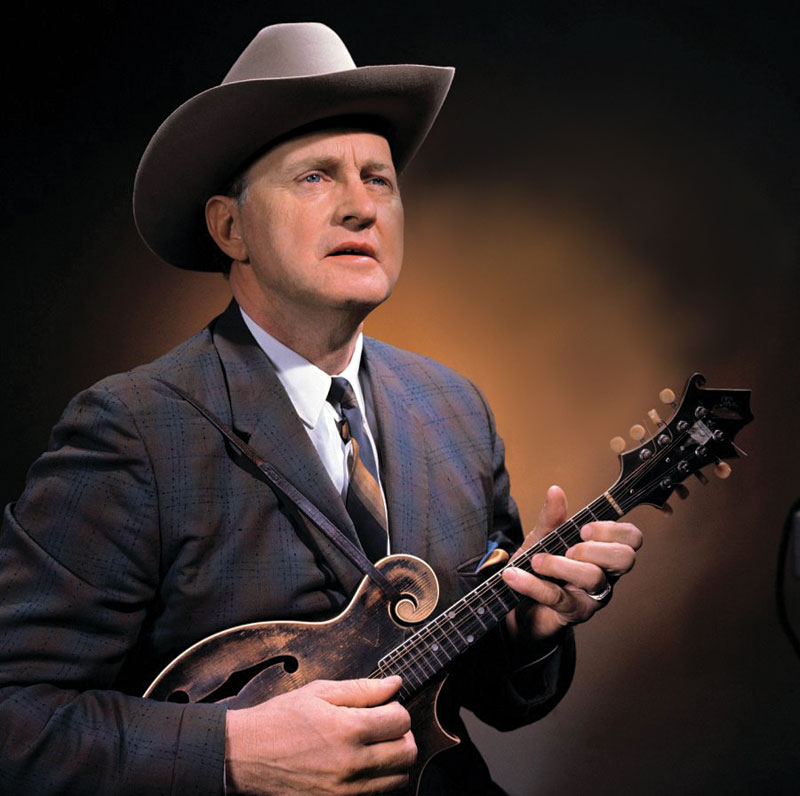
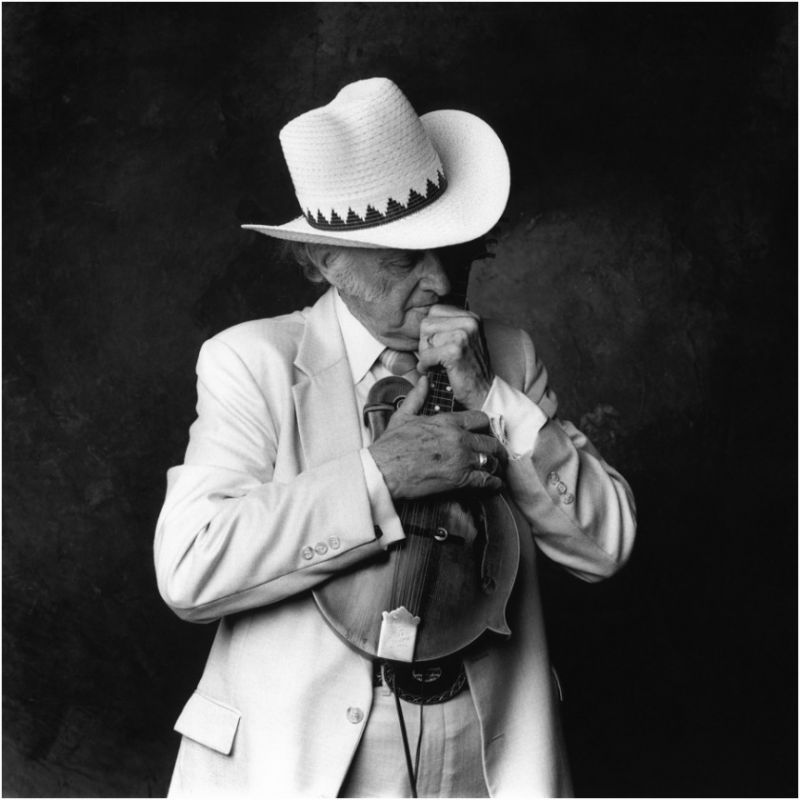
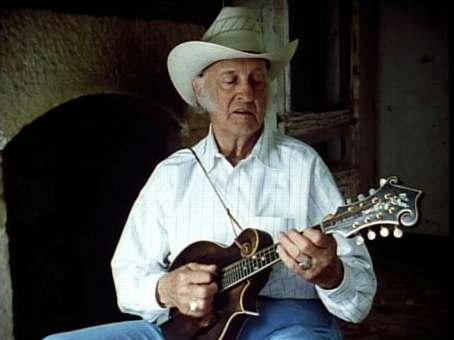
I’m a farmer with a mandolin and a high tenor voice.
~Bill Monroe
“To me there’s no difference between Muddy Waters and Bill Monroe.”
~Bob Dylan (to John Pareles, Sept 1997)
“Uncle Pen” from 1956 at the Ryman Auditorium:
From Wikipedia:
Birth name
William Smith Monroe
Also known as
Bill Monroe
Born
September 13, 1911
Origin
Rosine, Kentucky, USA
Died
September 9, 1996 (aged 84)
Genres
Bluegrass, Bluegrass gospel
Occupations
Bluegrass artist
Instruments
Mandolin
Years active
1930s–1996
William Smith Monroe (September 13, 1911 – September 9, 1996) was an American musician who created the style of music known as bluegrass, which takes its name from his band, the “Blue Grass Boys,” named for Monroe’s home state of Kentucky. Monroe’s performing career spanned 60 years as a singer, instrumentalist, composer and bandleader. He is often referred to as The Father of Bluegrass.
From allmusic.com – Stephen Thomas Erlewine:
Bill Monroe is the father of bluegrass. He invented the style, invented the name, and for the great majority of the 20th century, embodied the art form. Beginning with his Blue Grass Boys in the ’40s, Monroe defined a hard-edged style of country that emphasized instrumental virtuosity, close vocal harmonies, and a fast, driving tempo. The musical genre took its name from the Blue Grass Boys, and Monroe’s music forever has defined the sound of classical bluegrass — a five-piece acoustic string band, playing precisely and rapidly, switching solos and singing in a plaintive, high lonesome voice. Not only did he invent the very sound of the music, Monroe was the mentor for several generations of musicians. Over the years, Monroe’s band hosted all of the major bluegrass artists of the ’50s and ’60s, including Flatt & Scruggs, Reno & Smiley, Vassar Clements, Carter Stanley, and Mac Wiseman. Though the lineup of the Blue Grass Boys changed over the years, Monroe always remained devoted to bluegrass in its purest form. Read more @ allmusic
Awards & Legacy:
made an honorary Kentucky colonel in 1966
inducted into the Country Music Hall of Fame in 1970
inducted into the Nashville Songwriters Hall of Fame in 1971
inducted into the Rock and Roll Hall of Fame (as an “early influence”) in 1997
(Jimmie Rodgers, Bob Wills, Hank Williams Sr., and Johnny Cash are the only other performers honored in all three)
As the “father of bluegrass,” he was also an inaugural inductee into the International Bluegrass Music Hall of Honor in 1991.
In 1993, he received the Grammy Lifetime Achievement Award
he was awarded the National Medal of Arts in 1995
His well-known song “Blue Moon of Kentucky” has been covered not only by bluegrass but also rock and country artists, most notably Elvis Presley, Paul McCartney, and Patsy Cline.
In 2003, CMT had Bill Monroe ranked No. 16 on CMT 40 Greatest Men of Country Music.
Artists that claimed to be influenced by or to be playing the bluegrass genre were often bullied by Bill Monroe. He always considered himself the father and caretaker of bluegrass. He would often say of new bands that did not perform to his standards, “That ain’t no part of nothin’.” Even those who question the scope of bluegrass refer to Monroe as a “musical giant” and recognize that “there would be no bluegrass without Bill Monroe.”
“Blue Moon of Kentucky” – live:
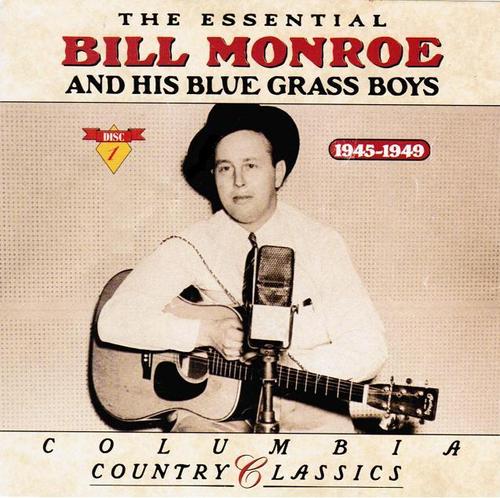
Album of the day: The Essential Bill Monroe and His Blue Grass Boys (1945-1949) (1992):