It’s Pete Townshend’s 68th birthday tomorrow.. & in addition to our upcoming calendar post .. here is a great list.
From the Oct.2009 edition of Uncut Magazine. Videos & pictures are included at top 15…
All quotations are from Uncut’s article.
30. Shakin’ All Over
29. Boris The Spider
28. Heaven And Hell
27. Sparks
26. Guitar And Pen
25. I’m One
24. Happy Jack
23. Magic Bus
22. Young Man Blues
21. Tea And Theatre
20. Pinball Wizard
19. Who Are You
18. Anyway Anyhow Anywhere
17. So Sad About Us
16. 5.15
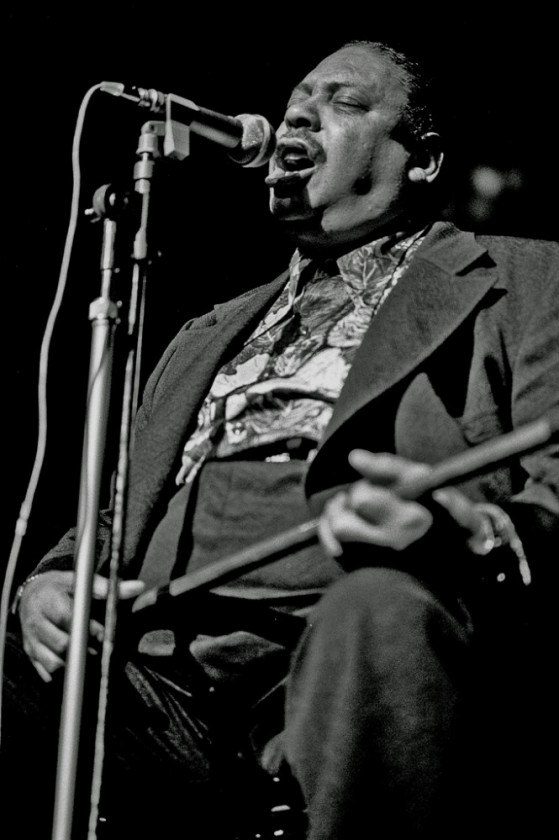
The premier blues shouter of the postwar era, Big Joe Turner’s roar could rattle the very foundation of any gin joint he sang within — and that’s without a microphone. Turner was a resilient figure in the history of blues — he effortlessly spanned boogie-woogie, jump blues, even the first wave of rock & roll, enjoying great success in each genre.
~Bill Dahl (allmusic.com)
Shake, Rattle & Roll:
Wikipedia:
Birth name
Joseph Vernon Turner Jr
Also known as
The Boss of the Blues
Born
May 18, 1911
Kansas City, Missouri, United States
Died
November 24, 1985 (aged 74)
Inglewood, California, United States
Genres
Jump blues, rock and roll, swing music
Instruments
Vocals
Years active
1920s – 1980s
Labels
Atlantic, National, Vocalion,Decca, Pablo
Associated acts
Pete Johnson, Count Basie Orchestra
Big Joe Turner (born Joseph Vernon Turner Jr., May 18, 1911 – November 24, 1985) was an American “blues shouter” (a blues-music singer capable of singing unamplified with a band) from Kansas City, Missouri. According to the songwriter Doc Pomus, “Rock and roll would have never happened without him.” Although he had his greatest fame during the 1950s with his rock and roll recordings, particularly “Shake, Rattle and Roll”, Turner’s career as a performer endured from the 1920s into the 1980s. Turner was inducted into the Rock and Roll Hall of Fame in 1987.
Oh Well, Oh Well:
Tributes:
The late The New York Times music critic Robert Palmer, said: “…his voice, pushing like a Count Basie solo, rich and grainy as a section of saxophones, which dominated the room with the sheer sumptuousness of its sound.”
In announcing Turner’s death in their December 1985 edition, the British music magazine, NME, described Turner as “the grandfather of rock and roll.”
Songwriter Dave Alvin wrote a song about an evening that he spent with Turner titled “Boss Of The Blues”. It was on his 2009 release, Dave Alvin & The Guilty Women.
Rolling Stone hailed it as the best ever live album, and they may still be right…
~Chris Jones (BBC – 2007)
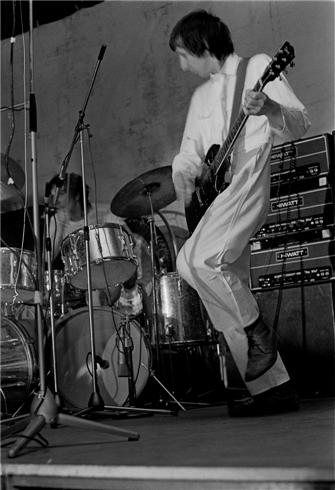
From youtube: The Who at Leeds for their greatest live in 1970! it’s the ONLY VIDEO of this concert!
Fortune Teller (0:00 to 0:05) –
Happy Jack (0:06 to 0:13) –
I’m a Boy (0:14 to 0:33) –
A Quick One While He’s Away (0:34 to 2:09) –
Christmas (2:10 to 3:05) –
Pinball Wizard (3:06 to 3:22) –
Go to The Mirror (3:22 to 3:26) –
Smash The Mirror (3:27 to 3:35)-
Tommy’s Holliday Camp (3:36 to 3:45) –
We’re Not Gonna Take It (with See Me, Feel Me) (3:46 at the end)
1970 Original LP – Full Album:
Wikipedia:
Released
16 May 1970
Recorded
14 February 1970,
University of Leeds,
Leeds, West Riding of Yorkshire,
England, United Kingdom
Genre
Rock
Length
36:24
Label
Decca/MCA
Producer
Jon Astley, Kit Lambert, and The Who
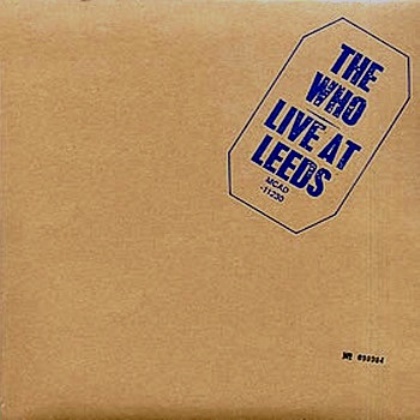
Live at Leeds is The Who’s first live album, and is the only live album that was released while the group were still actively recording and performing with their best known line-up of Roger Daltrey, Pete Townshend, John Entwistle and Keith Moon. Initially released in the United States on 16 May 1970, by Decca and MCA and the United Kingdom on 23 May 1970, by Track and Polydor, the album has been reissued on several occasions and in several different formats. As of 2005, the album is ranked number 170 on Rolling Stone magazine’s list of the 500 greatest albums of all time.
The album has been cited as the best live rock recording of all time by The Telegraph, The Independent, The New York Times,the BBC, and Rolling Stone. It is included in the book 1001 Albums You Must Hear Before You Die, and in Q magazine’s list of Loudest Albums of All Time. A Rolling Stone readers’ poll in 2012 ranked it the best live album of all time.
Shakin’ All Over:
Release History:
The original LP was released on 16 May 1970 in stereophonic format. The album was reissued on Compact Disc in 1985 by MCA in the US, and in 1987 by Polydor in Germany.
In 1995, the album was reissued as a remixed CD including more songs than the original vinyl edition, as well as song introductions and other banter that had been edited out of the original release. For the remix, new vocal overdubs from Daltrey, Townshend and Entwistle were recorded to address occasional flaws in the original tapes or performances.
In 2001, the album was released again as a part of the Universal Deluxe Edition series. The Deluxe Edition includes more chat between the songs, and the entirety of the band’s Tommy set as performed at Leeds. Again, new overdubs from the vocalists were employed at select points.
In October 2010, Universal Music announced the impending release of a 40th Anniversary edition of the album which would not only contain the full Leeds show from 14 February 1970 but also the band’s complete performance from Hull which was recorded the following evening as well as a heavyweight vinyl reproduction of the original six-track album, memorabilia and a replica 7 Inch Single of ‘Summertime Blues/ Heaven & Hell’. This performance had previously been unavailable because of a problem with the recording of John Entwistle’s bass guitar on the first six songs. To fix this problem his performance at the Leeds show was overdubbed over these tracks of the Hull performance using digital technology.
But the paradox is that while Sky Blue Sky is the smoothest sounding Wilco album, it also takes the longest to absorb and understand.
~Michael Metivier (popmatters.com)
..Wilco’s sixth studio album, Sky Blue Sky, sounds like the long-awaited follow-up to 1996’s Being There — while it lacks the ramshackle shape-shifting and broad twang of that earlier album, Sky Blue Sky represents a shift back to an organic sound and approach that suggests the influence of Neil Young’s Harvest and the more polished avenues of ’70s soft rock. Sky Blue Sky also marks Wilco’s first studio recordings since Nels Cline and Pat Sansone joined the group, and they certainly make their presence felt …
~Mark Deming (allmusic.com)
Impossible Germany (Live – from the DVD “Ashes Of American Flags”):
From Wikipedia:
Released
May 15, 2007
Recorded
November 2006 – January 2007 at The Wilco Loft, Irving Park, Chicago,Illinois, United States
Genre
Alternative rock, folk rock,alternative country
Length
50:56
Label
Nonesuch
Producer
Wilco
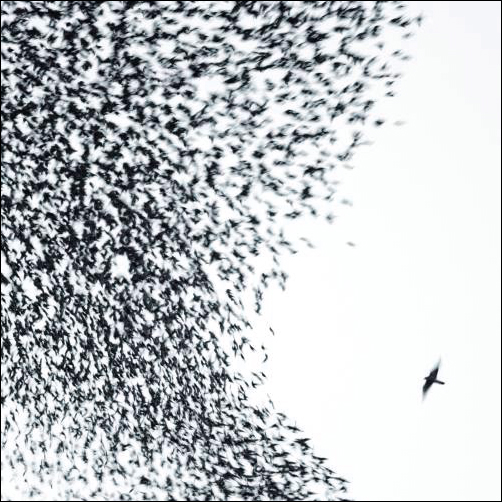
Sky Blue Sky is the sixth studio album by American rock band Wilco, released on May 15, 2007 by Nonesuch Records. Originally announced on January 17, 2007 at a show in Nashville, Tennessee, it was the band’s first studio album with guitarist Nels Cline and multi-instrumentalist Pat Sansone. Before its release, the band streamed the entire album on its official website and offered a free download of “What Light”.
Sky Blue Sky was Wilco’s highest debuting album on the Billboard 200 at number four. The self-produced album received mostly favorable reviews by critics. Publications such as PopMatters and Rolling Stone praised its maturity, while PlayLouder and Pitchfork Media criticized its “dad-rock” sound. While some critics praised the direct lyrical approach, others criticised it when compared to previous Wilco albums. The band licensed six songs from the Sky Blue Sky sessions to a Volkswagen advertisement campaign, a move that generated criticism from fans and the media.
You Are My Face (Austin City Limits 2007):
The album was recorded by TJ Doherty at The Loft in Irving Park, Chicago, where Tweedy had recorded Loose Fur’s Born Again in the USA and most of Wilco’s Yankee Hotel Foxtrot. In an interview with Billboard, the band revealed that the album would be less experimental than the two previous albums and more influenced by The Beatles, The Beach Boys, and The Rolling Stones. Also, unlike the previous albums, the album was made with only minimal involvement of Jim O’Rourke; the album which was produced with very few overdubs.
Release & reception
Nonesuch released the album on May 15, 2007; the following week became Wilco’s best-ever sales week. The album debuted at number four on the U.S. Billboard 200, selling 87,000 copies domestically in its first week. Sky Blue Sky was also an international success, peaking at number 7 in Norway, number 21 in Belgium, number 23 in Australia and Ireland, number 26 in Sweden, number 32 in New Zealand, number 36 in Germany, and number 39 in the United Kingdom.
The album received varied critical reception upon its release.
Rob Sheffield of Rolling Stone pondered in his review whether Wilco had ever made a song as good as “Impossible Germany,” praising how the song builds into a “twin guitar epic” in the mold of Television and Peter Green-era Fleetwood Mac.
Michael Metivier of PopMatters commented that while the album took a while to understand, it was full of “exquisitely beautiful melodies and performances”.
Allmusic writer Mark Deming called the album “Wilco’s strongest album as an ensemble to date,” and found the return to roots rock music a fresh new method for the band.
The album received a nomination at the 50th Annual Grammy Awards for Best Rock Album.
It placed 12th in the 2008 Pazz and Jop Poll.
This album was #42 on Rolling Stone‘s list of the Top 50 Albums of 2007, and the song “Impossible Germany” was #71 on Rolling Stone‘s list of the 100 Best Songs of 2007.
WXPN named “Impossible Germany” as the #1 song of 2007 and named the album as a whole the #1 album of 2007.
Sky Blue Sky was named one of the ten best albums of the year by Billboard, Paste Magazine, Uncut Magazine, and The Onion A.V. Club.
The album was placed at #97 on the Rolling Stone 100 Best Albums Of The 2000’s list.
Track Listing:
All songs written by Jeff Tweedy except as indicated.
“Either Way” – 3:05
“You Are My Face” (Tweedy, Cline) – 4:38
“Impossible Germany” (Tweedy, Wilco) – 5:57
“Sky Blue Sky” – 3:23
“Side with the Seeds” (Tweedy, Jorgensen) – 4:15
“Shake It Off” – 5:40
“Please Be Patient with Me” – 3:17
“Hate It Here” (Tweedy, Wilco) – 4:31
“Leave Me (Like You Found Me)” – 4:09
“Walken” (Tweedy, Wilco) – 4:26
“What Light” – 3:35
“On and On and On” (Tweedy, Wilco) – 4:00
Personnel:
Wilco
Nels Cline – electric guitar, 12 string guitar, lap steel guitar
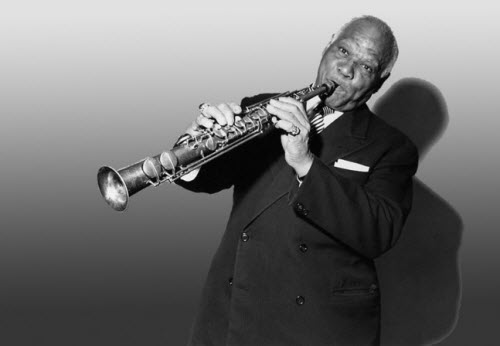
But drinking and reefers and all that stuff, most times they just mess up all the feeling you got inside yourself and all the feeling the music’s got inside itself. When a man goes at the music that way, it’s just a sign that there’s a lot inside himself he don’t know how to answer. He’s not knowing which way he needs to go. He’s not going anywhere at all.
~Sidney Bechet (Treat It Gentle: The Autobiography of Sidney Bechet)
Petite Fleur ( the Olympia Concert Paris, December 8, 1954):
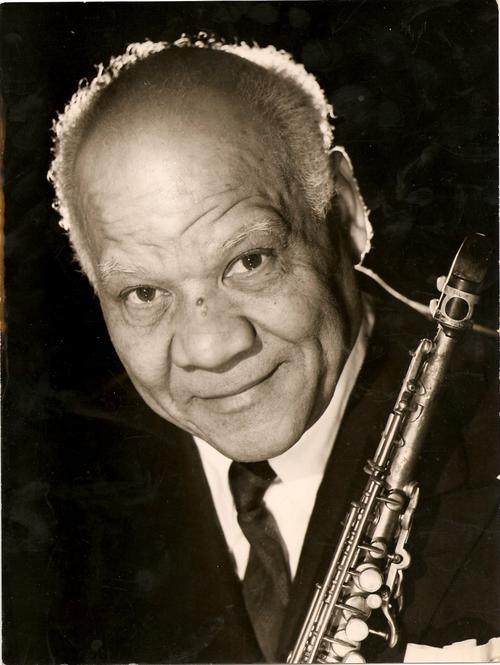
A brilliant soprano saxophonist and clarinetist with a wide vibrato that listeners either loved or hated, Bechet’s style did not evolve much through the years but he never lost his enthusiasm or creativity. A master at both individual and collective improvisation within the genre of New Orleans jazz, Bechet was such a dominant player that trumpeters found it very difficult to play with him. Bechet wanted to play lead and it was up to the other horns to stay out of his way.
~Scott Yanow (allmusic.com)
Wikipedia:
Born
May 14, 1897
New Orleans, Louisiana, U.S.
Died
May 14, 1959 (aged 62)
Garches, France
Genres
Jazz
Dixieland
Occupations
Clarinetist
Saxophonist
Composer
Instruments
Clarinet
Soprano saxophone
Years active
1908–1957
Associated acts
Louis Armstrong
Tommy Ladnier
Sidney Bechet (May 14, 1897 – May 14, 1959) was an American jazz saxophonist, clarinetist, and composer.
He was one of the first important soloists in jazz (beating cornetist and trumpeter Louis Armstrong to the recording studio by several months and later playing duets with Armstrong), and was perhaps the first notable jazz saxophonist. Forceful delivery, well-constructed improvisations, and a distinctive, wide vibrato characterized Bechet’s playing.
Bechet’s erratic temperament hampered his career, however, and not until the late 1940s did he earn wide acclaim.
Blue Horizon:
.. by combining the ‘cry’ of the blues players and the finesse of the Creoles into his ‘own way,’ Sidney Bechet created a style which moved the emotions even as it dazzled the mind.
~Robert Palmer