Posters and flyers are an integral part of promoting concerts and music festivals. A well-designed gig poster will help any band to look more cool and can help to generate interest for the artists and their show.
It started in the 60s with the psychedelic images of the hippie scene. It got a revival with DIY of the punk scene in the late 70s and there is a revival these days. What am I talking about? The Gig posters. The silk screen prints done in a limited number of prints and works of art in their own right, but also the mass-produced pr material used by big arena artists. The originality of these posters are sometimes more striking than the music itself.
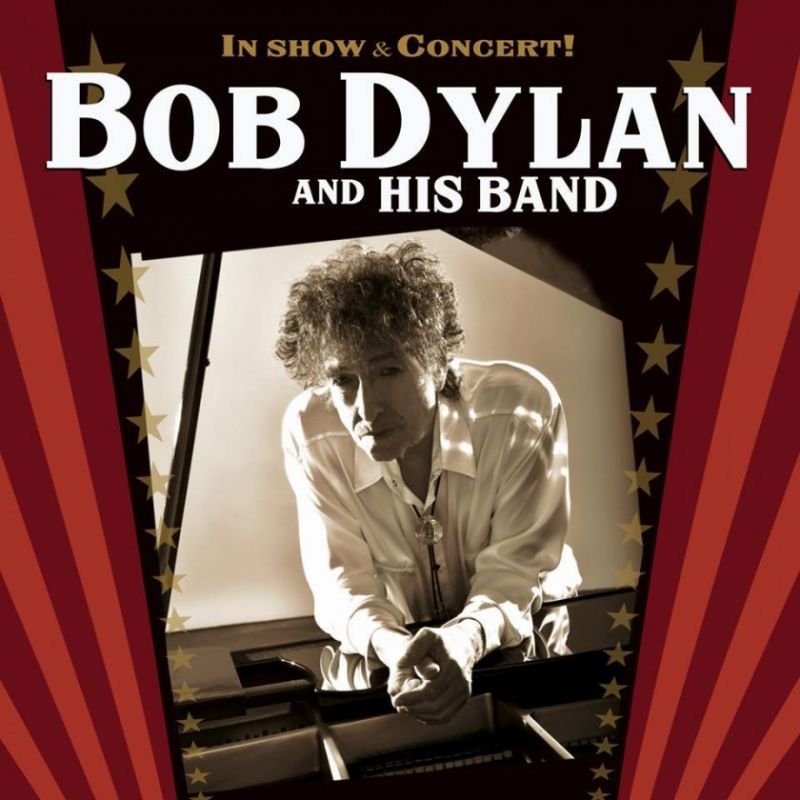
Bob Dylan have always had nice gig posters, and they have gone through changes as the artist has changed from the 60s until today.
Oh, six long years I’ve been in trouble, No pleasure here on earth I found. While in this world, I’m bound to ramble, I have no friends to help me out.
“Man of Constant Sorrow” (also known as “I Am a Man of Constant Sorrow“) is a traditional American folk song first recorded by Dick Burnett, a partially blind fiddler from Kentucky. The song was originally recorded by Burnett as “Farewell Song” printed in a Richard Burnett songbook, about 1913. An early version was recorded by Emry Arthur in 1928.
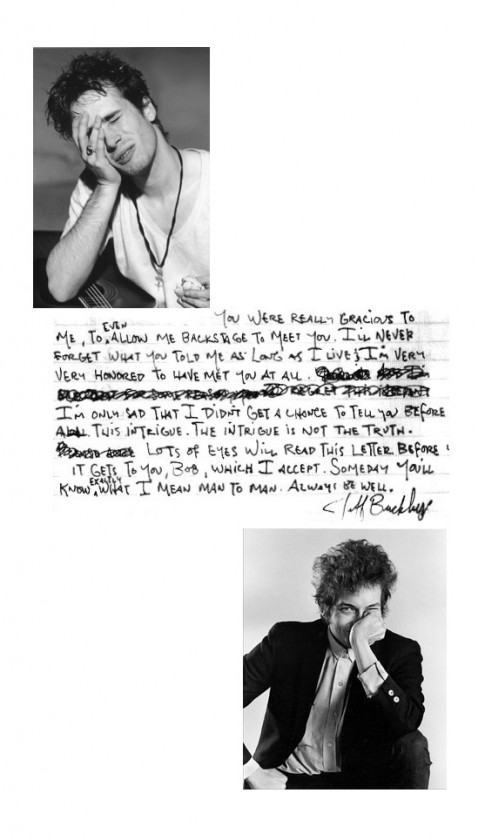
Here is a 1993 clip of Jeff Buckley at a poetry event, reading an apology letter he wrote to his idol Bob Dylan. The reading is included on a CD accompanying the book The Spoken Word Revolution Redux.
“Dear Bob,
And I don’t know what purpose this will serve at all.
I don’t know how to start. Last Saturday, my man, Steve Burkowitz, broke it to me that you were told of something I said from the stage and that you’d felt insulted. I need for you to listen to me. I have no way of knowing how my words are translated to you, if they’re whole meaning and context are intact, but the truth is that I was off on a tangent, on a stage, my mind going where it goes, trying to be funny, it wasn’t funny at all and I fucked up, I really fucked up.
And the worst of it isn’t that your boys were at the gig to hear it. It doesn’t really bother me. It just kills me to know that whatever they told you was what you think I think of you-
not that I love you, not that I’ve always listened to you and carried the music with me wherever I go, not that I believe in you and also that your show was great. It was only the separate club crowd that I was cynical about and that’s what I was trying to get at when I said what I said.And I’m sorry that I’ll never get to make another first impression. You were really gracious to me, to even allow me backstage to meet you. I’ll never forget you, what you told me for as long as I live. He said “Make a good record man” and I’m very honored to have met you at all. He said some other shit too,
I’m only sad that I didn’t get a chance to tell you before all this intrigue, the intrigue is not the truth. Lots of eyes will read this letter before it gets to you, Bob, which I accept. Someday you will know exactly what I mean, man to man.
Always be well, Jeff Buckley
And you know who’s going to read this? The President of Sony Records, my A&R man, my manager, his two managers, his friend Ratzo, and this is my personal plea of love to Bob Dylan, and this is what happens when you’re not nobody anymore.”
Here are the songs that Jeff Buckley sang and Bob Dylan wrote.
Just Like A Woman – Jeff Buckley, Live at Palais Theatre, Melbourne on February 27 1996:
The Revelation of Jesus Christ, which God gave unto him, to shew unto his servants things which must shortly come to pass; and he sent and signified it by his angel unto his servant John: Who bare record of the word of God, and of the testimony of Jesus Christ, and of all things that he saw. Blessed is he that readeth, and they that hear the words of this prophecy, and keep those things which are written therein: for the time is at hand.
– Revelation 1:1-3
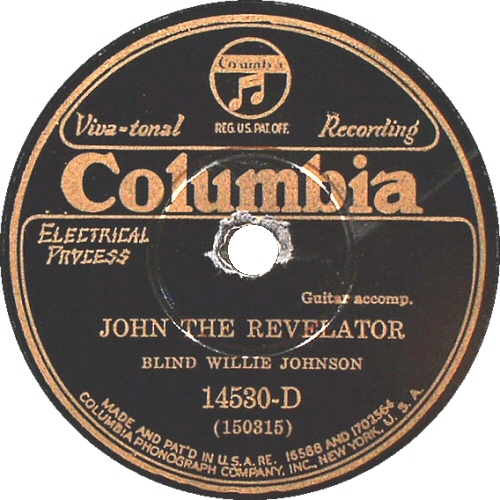
John the Revelator is a traditional gospel blues call and response song. Music critic Thomas Ward describes it as “one of the most powerful songs in all of pre-war acoustic music … [which] has been hugely influential to blues performers”. Blind Willie Johnson recorded John the Revelator in 1929 (or 1930) and is the first known recording (at least to me) and subsequently a variety of artists have recorded their renditions of the song, often with variations in the verses and music.
The song’s title refers to John of Patmos (or traditionally John the Apostle) in his role as the author of the Book of Revelation. A portion of that book focuses on the opening of seven seals and the resulting apocalyptic events. In its various versions, the song quotes several passages from the Bible in the tradition of American spirituals.
This is a dark and brooding masterpiece!
The Blind Willie Johnson version:
Blind Willie Johnson recorded the song on April 20, 1929 (or 1930) in Atlanta (his second (1929) or his fifth and final recording session for Columbia Records (1930)). He is accompanied by his first wife (probably), Willie B. Harris. Johnson was a gospel blues singer and guitarist. While the lyrics of his songs were usually religious, his music drew from both sacred and blues traditions. It is characterized by his slide guitar accompaniment and tenor voice, and his frequent use of a lower-register ‘growl’ or false bass voice.
“One place you’re going to find a lot of doctors is St. James Infirmary. This song’s history is convoluted and fascinating. Louis Armstrong recorded it as early as nineteen and twenty-eight, but it goes back much further. According to one study it got its start as a ballad called ‘The Unfortunate Rake’…”
– Bob Dylan (Theme Time Radio Hour, Doctors)
The Best Songs: St. James Infirmary blues
“St. James Infirmary Blues” is an American folksong of anonymous origin, though sometimes credited to the songwriter Joe Primrose (a pseudonym for Irving Mills). Louis Armstrong made it famous in his influential 1928 recording.
There are hundreds of recordings and it has been difficult to choose my favourites. I’ve tried to pick some for their historic significance and some just because they are so incredibly good.
“St. James Infirmary” is based on an 18th-century traditional English folk song called “The Unfortunate Rake” (also known as “The Unfortunate Lad” or “The Young Man Cut Down in His Prime”), about a soldier who uses his money on prostitutes, and then dies of a venereal disease.
My first pick is an a cappella version of The Unfortunate Rake done by Ian McShane from the TV-series Deadwood (we can also clearly hear the melody that became Streets of Laredo):