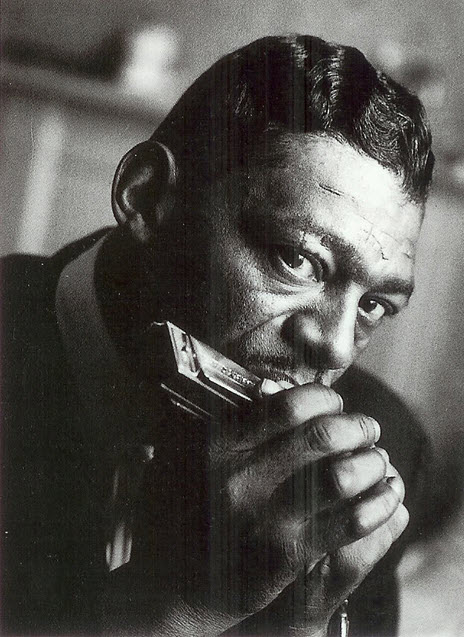
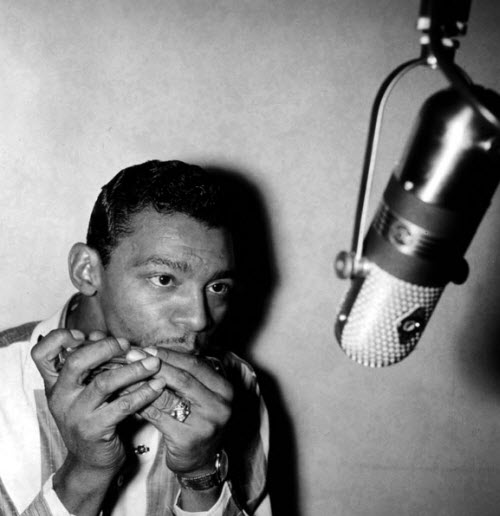
..king of all post-war blues harpists,…. The fiery harmonica wizard took the humble mouth organ in dazzling amplified directions that were unimaginable prior to his ascendancy.
~Bill Dahl (allmusic.com)
Induction of Little Walter into R&R Hall of Fame in 2008:
Walter’s Jump – Live @ American Folk Blues Festival 1967, Germany:
Wikipedia:
Little Walter, born Marion Walter Jacobs (May 1, 1930 – February 15, 1968), was an American blues harmonica player, whose revolutionary approach to his instrument has earned him comparisons to Charlie Parker and Jimi Hendrix, for innovation and impact on succeeding generations. His virtuosity and musical innovations fundamentally altered many listeners’ expectations of what was possible on blues harmonica. Little Walter was inducted to the The Rock and Roll Hall of Fame in 2008 in the “sideman” category making him the first and only artist ever to be inducted specifically for his work as a harmonica player.
Juke:
His legacy has been enormous: he is widely credited by blues historians as the artist primarily responsible for establishing the standard vocabulary for modern blues and blues rock harmonica players. His influence can be heard in varying degrees in virtually every modern blues harp player who came along in his wake, from blues greats such as Junior Wells, James Cotton, George “Harmonica” Smith, Carey Bell, and Big Walter Horton, through modern-day masters Sugar Blue, Billy Branch, Kim Wilson, Rod Piazza, William Clarke, and Charlie Musselwhite, in addition to blues-rock crossover artists such as Paul Butterfield and John Popper of the band Blues Traveler. Little Walter was portrayed in the 2008 film, Cadillac Records, by Columbus Short.
Awards & recognition:
1986 – Blues Hall of Fame: “Juke” (Classics of Blues Recordings – Singles or Album Tracks category)
1991 – Blues Hall of Fame: Best of Little Walter (Classics of Blues Recordings – Albums category)
1995 – Rock and Roll Hall of Fame: “Juke” (500 Songs that Shaped Rock and Roll)
2003 – Rolling Stone: Best of Little Walter (#198 on list of The 500 Greatest Albums of All Time)
2008 – Grammy Awards: “Juke” (Grammy Hall of Fame Award)
2008 – Rock and Roll Hall of Fame: Little Walter inducted (Sideman category)
2008 – Blues Hall of Fame: “My Babe” (Classics of Blues Recordings – Singles or Album Tracks category)
2009 – Grammy Awards The Complete Chess Masters: 1950–1967 (Best Historical Album Winner)
…Sure, I try to stick to the rules. Sometimes I might shift paradigms within the same song, but then that structure also has its own rules. And I combine them both, see what works and what doesn’t. My range is limited. Some formulas are too complex and I don’t want anything to do with them.
~Bob Dylan (to Bill Flanagan, in 2009)
“Dylan, who turns 68 in May, has never sounded as ravaged, pissed off and lusty”
~David Fricke (rollingstone.com)
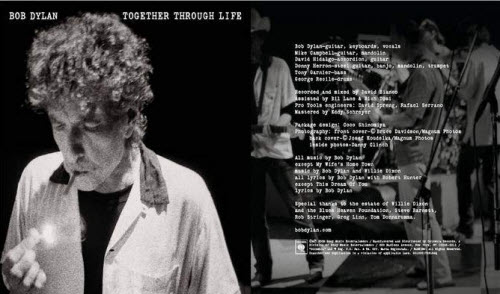
Together Through Life is an album that gets its hooks in early and refuses to let go. It’s dark yet comforting, with a big tough sound, booming slightly like a band grooving at a soundcheck in an empty theatre. And at its heart there is a haunting refrain. Because above everything this is a record about love, its absence and its remembrance.
~Danny Eccleston (mojo4music.com)
Beyond Here Lies Nothin’
I’m listening to Billy Joe Shaver
And I’m reading James Joyce
Some people they tell me
I got the blood of the land in my voice
~Bob Dylan (I Feel A Change Comin’ On)
Wikipedia:
Released
April 28, 2009
Recorded
December 2008
Genre
Folk rock, blues rock, Americana
Length
45:33
Language
English
Label
Columbia
Producer
Jack Frost (Bob Dylan pseudonym)
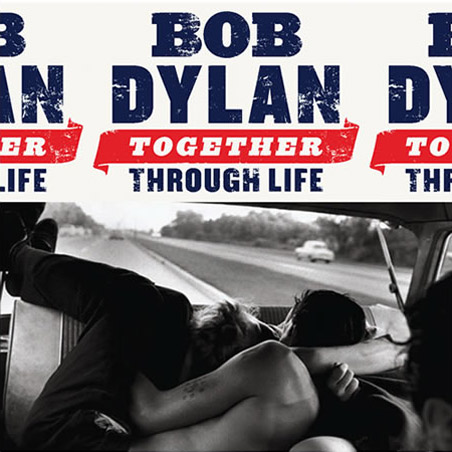
Together Through Life is the thirty-third studio album by singer-songwriter Bob Dylan, released in April 2009 by Columbia Records. The album debuted at number one in several countries, including the U.S. and the UK. It is Dylan’s first number one in Britain since New Morning in 1970.
Dylan wrote all but one of the album’s songs with Grateful Dead lyricist Robert Hunter, with whom he had previously co-written two songs on his 1988 album Down in the Groove. In an interview with Rolling Stone magazine, Dylan commented on the collaboration:
“Hunter is an old buddy, we could probably write a hundred songs together if we thought it was important or the right reasons were there… He’s got a way with words and I do too. We both write a different type of song than what passes today for songwriting.”
The only other writer Dylan has ever collaborated with to such a degree is Jacques Levy, with whom he wrote most of the songs on Desire (1976).
Rumors of the album, reported in Rolling Stone magazine, came as a surprise, with no official press release until March 16, 2009 — less than two months before the album’s release date. Dylan produced the record under his pseudonym of Jack Frost, which he used for his previous two studio albums, “Love and Theft” and Modern Times. The album was rumored to contain “struggling love songs” and have little similarity to Modern Times.
In a conversation with music journalist Bill Flanagan, published on Bob Dylan’s official website, Flanagan suggested a similarity of the new record to the sound of Chess Records and Sun Records, which Dylan acknowledged as an effect of “the way the instruments were played.” He said that the genesis of the record was when French film director Olivier Dahan asked him to supply a song for his new road movie, My Own Love Song, which became “Life is Hard” – indeed, ‘according to Dylan, Dahan was keen to get a whole soundtrack’s worth of songs from the man’ – and “then the record sort of took its own direction.”
Beyond Here Lies Nothin’ live 2011 Tucson, AZ:
Dylan is backed on the album by his regular touring band, plus David Hidalgo of Los Lobos and Mike Campbell of Tom Petty and the Heartbreakers. Dylan commented on Campbell’s guitar work in his interview with Flanagan: “He’s good with me. He’s been playing with Tom for so long that he hears everything from a songwriter’s point of view and he can play most any style.”
In the interview with Bill Flanagan, Dylan discusses the only known outtake to “Together Through Life”, “Chicago After Dark”. Apparently, this song was in the running to be on the album but was left off the final version, as Flanagan talks about the song as if it is on the album. The song is not circulating among collectors.
“Bill Flanagan: In that song CHICAGO AFTER DARK, were you thinking about the new President?
Bob: Not really. It’s more about State Street and the wind off Lake Michigan and how sometimes we know people and we are no longer what we used to be to them. I was trying to go with some old time feeling that I had.”
—
Described at length in a 2009 interview to promote the album Together Through Life, according to Dylan, it’s about “how sometimes we know people and we are no longer what we used to be to them”. In fact, this song never existed.He made it all up. How fitting. ~Clinton Heylin (telegraph.co.uk)
Forgetful Heart, Memphis, 2011:
The album received two Grammy Award nominations in Best Americana Album category and “Best Solo Rock Vocal Performance” category for “Beyond Here Lies Nothin'”.
The album also is significant as the only album by Dylan to top the US and UK charts consecutively.
The album’s cover photo is the same as that on the cover of American author Larry Brown’s short story collection, Big Bad Love.
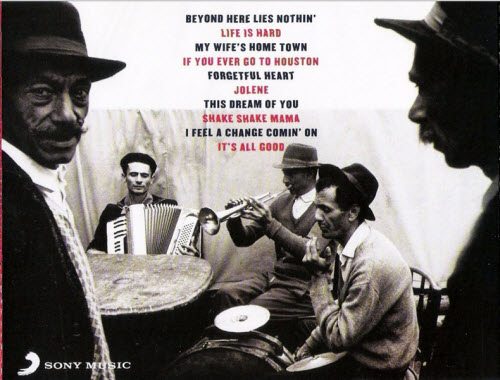
Track listing:
“Beyond Here Lies Nothin'” 3:51
“Life Is Hard” 3:39
“My Wife’s Home Town” (Willie Dixon, Dylan, Hunter) 4:15
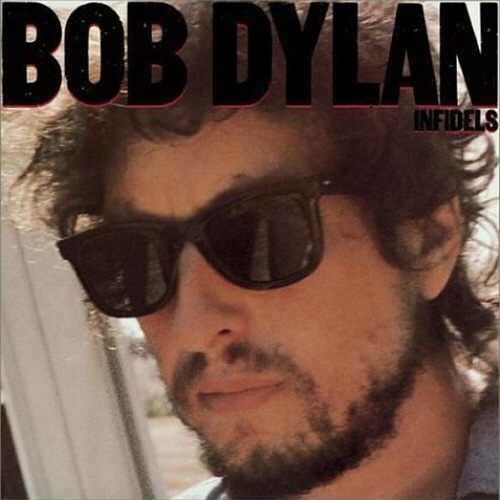
…..I did the album, and I call it that, but what it means is for other people to interpret, you know, if it means something to them. Infidels is a word that’s in the dictionary and whoever it applies to… to everybody on the album, every character. Maybe it’s all about infidels.
~Bob Dylan (to Kurt Loder in March 1984)
Foot of Pride:
“Bob’s musical ability is limited, in terms of being able to play a guitar or a piano,….. It’s rudimentary, but it doesn’t affect his variety, his sense of melody, his singing. It’s all there. In fact, some of the things he plays on piano while he’s singing are lovely, even though they’re rudimentary. That all demonstrates the fact that you don’t have to be a great technician. It’s the same old story: If something is played with soul, that’s what’s important.”
~Mark Knopfler
“I’ve made shoes for everyone, even you, while I still go barefoot”
~Bob Dylan (from “I and I”)
Studio A Power Station New York City, New York 27 April 1983
Produced by Mark Knopfler and Bob Dylan
From Paul
Foot Of Pride
Foot Of Pride
Foot Of Pride
Foot Of Pride ….Composing it was alright, it probably had a bunch of extra verses that probably… most likely weren’t necessary, they should have been… they should have been combined. But, the reason why it was never used was because the tempo speeded up, but there wasn’t any drum machine used on that, the tempo just automatically took off, for some vague and curious reason. ~Bob Dylan (to Eliot Mintz – March 1991) – Foot of pride is in fact, in the words Dylan used to describe the composition “Like A Rolling Stone,” “a long piece of vomit”. … it’s about how pride destroys us and turns us into monsters. ~Paul Williams (BD performing artist 1974-86)
Union Sundown
Union Sundown
(Unidentified Song)
(Harmonica)
(Unidentified Song)
I And I
I And I
I And I
I And I
I And I
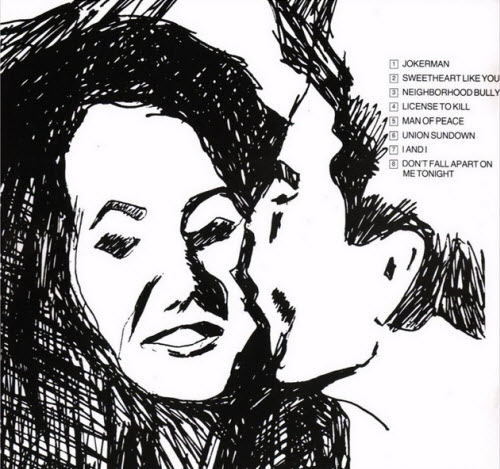
I And I …according to author/critic Tim Riley, “updates the Dylan mythos. Even though it substitutes self-pity for the [pessimism found throughout Infidels], you can’t ignore it as a Dylan spyglass: ‘Someone else is speakin’ with my mouth, but I’m listening only to my heart/I’ve made shoes for everyone, even you, while I still go barefoot.'” Riley sees the song as an exploration of the distance between Dylan’s “inner identity and the public face he wears”. ~Wikipedia – “I and I”, the other epic from these sessions, is a beautiful song, powerfully sung, with a wonderfully moody and evocative instrumental setting…. ~Paul Williams (BD perfroming artist 1974-86)
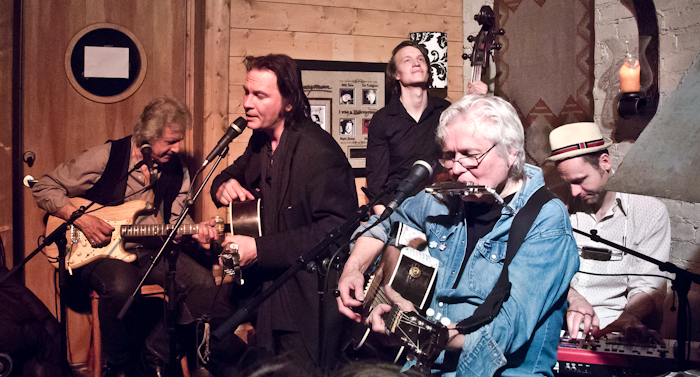
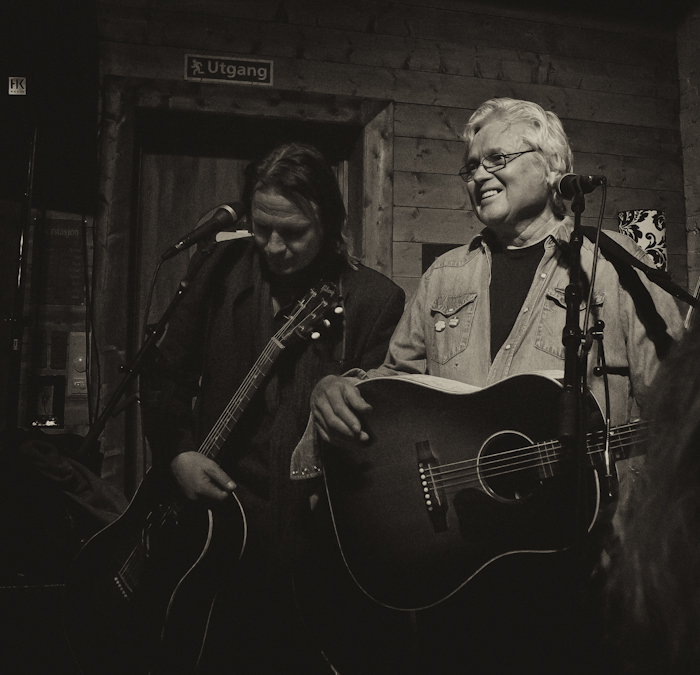
We have just come home from a wonderful concert. Paal Flaata and Chip Taylor played at Smio in Vea. They had John Platania on guitar, Gøran Grini on el-piano and Paul Vikingstad was the sound guy (plus bass on the last two songs).
The show was sold out, it is a very small venue with, I think, a capacity of about 50 people. Very intimate. When the band played, they closed the toilet and they closed the bar. We were urged to listen and enjoy the music, but to do the talking before and after the show. Great rules! …and it’s sold out tomorrow as well. Continue reading Paal Flaata and Chip Taylor at Smio – Photo special→