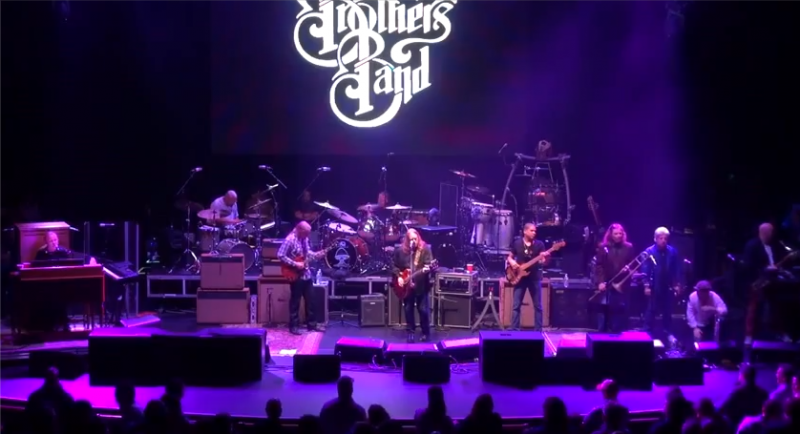
A wonderful version of Tears of Rage (Dylan/the Band) from earlier this month at The Beacon Theater.
Wikipedia:
The song was first recorded in rehearsal sessions at The Band’s upstate New York residence, “Big Pink”, in 1967, with Dylan on lead vocal and The Band backing him. This recording and those from the rest of the sessions would not be officially released for another eight years, on the 1975 album, The Basement Tapes, although they were widely bootlegged in the late 1960s and early ’70s. It is considered one of the most widely acclaimed from The Basement Tapes.
The first official release of the song was as the first track on The Band’s debut, 1968 album Music from Big Pink, without Dylan and featuring Manuel on lead vocal. According to Levon Helm, “Richard sang one of the best performances of his life.”
..His talent takes many forms. He is one of the most compelling white blues singers ever recorded. He is a songwriter of exceptional facility and cleverness. He is an uncommonly skillful guitar player and harmonica player.
~Stacy Williams (“Bob Dylan” LP. liner notes)
Dylan’s first album can hardly be faulted. It is a brilliant debut, a performer’s tour de force,….
~Michael Gray (BD Encyclopedia)
Talkin’ New York:
Wikipedia:
Released
March 19, 1962
Recorded
November 20 and 22, 1961,Columbia Recording Studio, New York City, New York, United States
Genre
Folk
Length
36:54
Label
Columbia
Producer
John H. Hammond
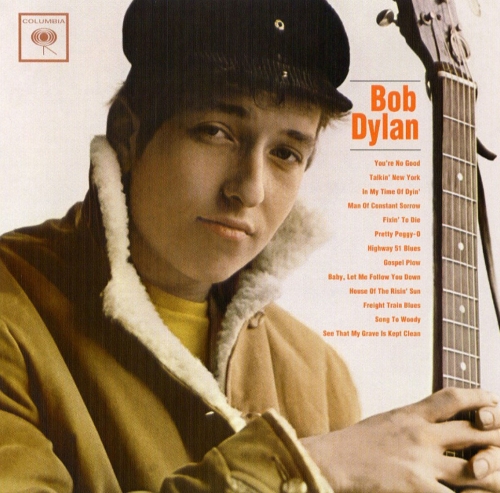
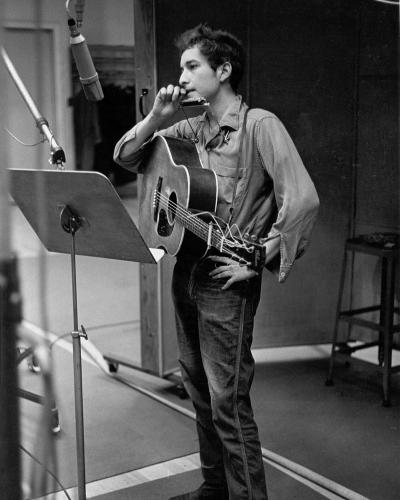
Bob Dylan is the debut album by American singer-songwriter Bob Dylan, released in March 1962 by Columbia Records. Produced by Columbia’s legendary talent scout John H. Hammond, who signed Dylan to the label, the album features folk standards, plus two original compositions, “Talkin’ New York” and “Song to Woody”.
Man of Constant Sorrow:
Recording sessions
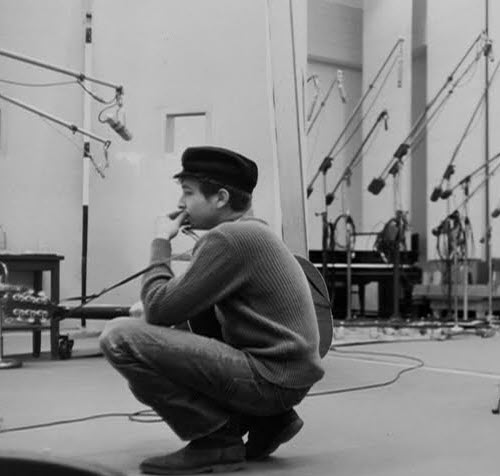
The album was ultimately recorded in three short afternoon sessions on November 20 and 22 (1961). Hammond later joked that Columbia spent “about $402” to record it, and the figure has entered the Dylan legend as its actual cost. Despite the low cost and short amount of time, Dylan was still difficult to record, according to Hammond. “Bobby popped every p, hissed every s, and habitually wandered off mike,” recalls Hammond. “Even more frustrating, he refused to learn from his mistakes. It occurred to me at the time that I’d never worked with anyone so undisciplined before.”
Seventeen songs were recorded, and five of the album’s chosen tracks were actually cut in single takes (“Baby Let Me Follow You Down,” “In My Time of Dyin’,” “Gospel Plow,” “Highway 51 Blues,” and “Freight Train Blues”) while the master take of “Song to Woody” was recorded after one false start. The album’s four outtakes were also cut in single takes. During the sessions, Dylan refused requests to do second takes. “I said no. I can’t see myself singing the same song twice in a row. That’s terrible.”
The album cover features a reversed photo of Dylan holding his acoustic guitar. It is unknown as to why the photo was flipped.
In My Time of Dyin:
In less than one year in New York, Bob Dylan has thrown the folk crowd into an uproar. Ardent fans have been shouting his praises. Devotees have found in him the image of a singing rebel, a musical Chaplin tramp, a young Woody Guthrie, or a composite of some of the best country blues singers.
~Stacy Williams (“Bob Dylan” LP. liner notes)
Track Listing:
Side one
“You’re No Good” – Jesse Fuller 1:40
“Talkin’ New York” – Bob Dylan 3:20
“In My Time of Dyin'” – trad. arr. Dylan 2:40
“Man of Constant Sorrow” – trad. arr. Dylan 3:10
“Fixin’ to Die” – Bukka White 2:22
“Pretty Peggy-O” – trad. arr. Dylan 3:23
“Highway 51” – Curtis Jones 2:52
Side two
“Gospel Plow” – trad. arr. Dylan 1:47
“Baby, Let Me Follow You Down” – trad. arr. Eric von Schmidt 2:37
“House of the Risin’ Sun” – trad. arr. Dave Van Ronk 5:20
“Freight Train Blues” – trad., Roy Acuff 2:18
“Song to Woody” – Bob Dylan 2:42
“See That My Grave Is Kept Clean” – Blind Lemon Jefferson 2:43
Personnel:
Bob Dylan – vocals, acoustic guitar, harmonica
Technical personnel
John H. Hammond – production
Baby, Let Me Follow You Down:
The Songs:
By the time sessions were held for his debut album, Dylan was absorbing an enormous amount of folk material from sitting and listening to contemporaries performing in New York’s clubs and coffeehouses. Many of these individuals were also close friends who performed with Dylan, often inviting him to their apartments where they would introduce him to more folk songs. At the same time, Dylan was borrowing and listening to a large number of folk, blues, and country records, many of which were hard to find at the time. Dylan revealed in an interview in the documentary No Direction Home that he needed to hear a song only once or twice to learn it.
The final album sequence of Bob Dylan features only two original compositions; the other eleven tracks are folk standards and traditional songs. Few of these were staples of his club/coffeehouse repertoire. Only two of the covers and both originals were in his club set in September 1961.
Dylan stated in a 2000 interview that he was hesitant to reveal too much of himself at first.
See That My Grave is Kept Clean:
Aftermath
Bob Dylan did not receive much acclaim until years later. “These debut songs are essayed with differing degrees of conviction,” writes music critic Tim Riley, “[but] even when his reach exceeds his grasp, he never sounds like he knows he’s in over his head, or gushily patronizing… Like Elvis Presley, what Dylan can sing, he quickly masters; what he can’t, he twists to his own devices. And as with the Presley Sun sessions, the voice that leaps from Dylan’s first album is its most striking feature, a determined, iconoclastic baying that chews up influences, and spits out the odd mixed signal without half trying.”
However, at the time of its release, Bob Dylan received little notice, and both Hammond and Dylan were soon dismissive of the first album’s results.
Bob Dylan’s first album is a lot like the debut albums by the Beatles and the Rolling Stones — a sterling effort, outclassing most, if not all, of what came before it in the genre, but similarly eclipsed by the artist’s own subsequent efforts. The difference was that not very many people heard Bob Dylan on its original release (originals on the early-’60s Columbia label are choice collectibles) because it was recorded with a much smaller audience and musical arena in mind.
~Bruce Eder (allmusic.com)
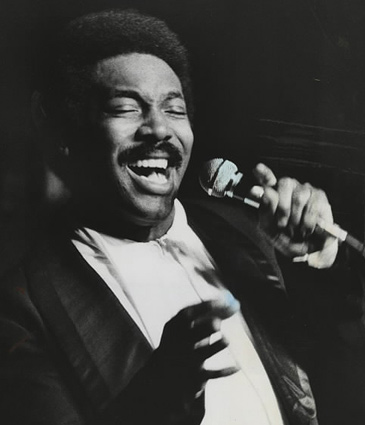
Wilson Pickett was born March 18, 1941 and he died January 19, 2006.
A major figure in the development of American soul music, Pickett recorded over 50 songs which made the US R&B charts, and frequently crossed over to the US Billboard Hot 100.
The early hit I Found A Love with The Falcons (audio only 1962):
Wilson Pickett was one of the rawest and sweatiest, singing some of soul’s best dancefloor grooves. He had hits a plenty: “In the Midnight Hour,” “Land of 1000 Dances,” “Mustang Sally,” and “Funky Broadway” and more.
He is often a preferred alternative of fans who like their soul on the raw side. He also played an important part in establishing Southern soul as a vital part of the soul genre.
His hits were often written and recorded with the very best of the session musicians in Memphis and Muscle Shoals.
The impact of Pickett’s songwriting and recording led to his 1991 induction into the Rock and Roll Hall of Fame.
Land of 1000 Dances – Live:
There are very few songs by “The Wicked” Picket on Spotify so we have included a fabulous radio documentary from BBC. Roger Daltrey, lead singer of The Who and a Wilson Pickett fan, tells the story of the soul legend:
I have to include an audio clip of my favourite Pickett recording, Engine #9:
Alex Chilton, power pop genius died 17. March in 2010 three years ago today.
Paul Westerberg wrote these words in The New York Times three days after Alex Chilton passed away:
It was some years back, the last time I saw Alex Chilton. We miraculously bumped into each other one autumn evening in New York, he in a Memphis Minnie T-shirt, with take-out Thai, en route to his hotel. He invited me along to watch the World Series on TV, and I immediately discarded whatever flimsy obligation I may have had. We watched baseball, talked and laughed, especially about his current residence — he was living in, get this, a tent in Tennessee.
Because we were musicians, our talk inevitably turned toward women, and Al, ever the Southern gentleman, was having a hard time between bites communicating to me the difficulty in … you see, the difficulty in (me taking my last swig that didn’t end up on the wall, as I boldly supplied the punch line) “… in asking a young lady if she’d like to come back to your tent?” We both darn near died there in a fit of laughter.
Yeah, December boys got it bad, as “September Gurls” notes. The great Alex Chilton is gone — folk troubadour, blues shouter, master singer, songwriter and guitarist. Someone should write a tune about him. Then again, nah, that would be impossible. Or just plain stupid.
He is one the all time best pop melody makers, he’s up there with Paul McCartney, Brian Wilson and Pete Townsend. When you hear his songs for the first time you’ll swear you’ve heard it before, but you have not. It is just so instantly recognizable, so familiar and so right!
The Box Tops – The Letter:
Alex Chilton was involved in great music all his life, he was like the music worlds Coen brothers, they may be making some movies that are not fantastic, but they are always good. And in most cases better and more interesting than anything else out there. Chilton had a very consistent career and deserved so much more recognition than he got.
The Ballad of El Goodo (live, 93):
It is difficult to get across the admiration I have for Alex Chilton, let’s just say that he is one of the all time best and listen to his music.
Oh, and I think we should include that “stupid”song that Mr. Westerberg is talking about above. Alex Chilton, here in a solo Paul Westerberg live clip:
Alex Chilton defined the term cult hero. He was difficult, mercurial, endlessly self-sabotaging and, for a brief time, utterly brilliant. His 70s group Big Star remain almost unknown to the mainstream but are one of the key abiding influences in rock music of any calibre, their short life only fuelling their near-mythical status. “I never travel far without a little Big Star,” sang the Replacements on their strange love song, “Alex Chilton”. Several influential rock groups, from REM to Primal Scream, Teenage Fanclub to Wilco, would echo that sentiment. REM’s Peter Buck once described Big Star as “a Rosetta stone for a whole generation”.
My (Hallgeir) list of Alex Chilton’s top 21 songs (actually 22, I had to include The Letter even if he didn’t write that one):