This is a new series (hopefully). We we seek out and present unreleased songs by various artists. Check out the About Us page and you’ll get a picture of what artists we are concentrating this series on. This does not mean that we will only do songs by these artists/groups, but our focus will be on that list.
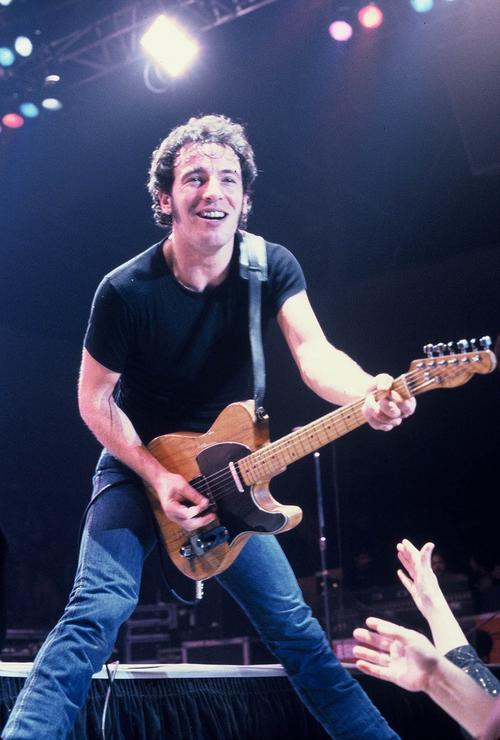
We will start with a Born in the U.S.A. outtake by Bruce Springsteen. We are eagerly waiting for Tracks part 2, The Boss have a lot of great songs that are still unreleased.
I stand alone at my window I see you waiting in the shadows down below I feel your fingers on my face I know I want to stay, but I want to run away
Our first unreleased track is Protection, here in a studio version by Bruce Springsteen and the E-Street band:
It was recorded in Jan-Feb 1982 at the Hit Factory in New York. “Protection” is written by Bruce Springsteen for Donna Summer. It was originally featured on the 1982 Donna Summer album which was produced by Quincy Jones.
Record executive David Geffen, a friend Jon Landau, asked Landau if his client could write something for Donna Summer who had joined his label Geffen Records. The idea was that Springsteen and Summer record the song as a duet, so Springsteen wrote Cover Me!
She could really sing and I disliked the veiled racism of the anti-disco movement
– Bruce Springsteen (Songs)
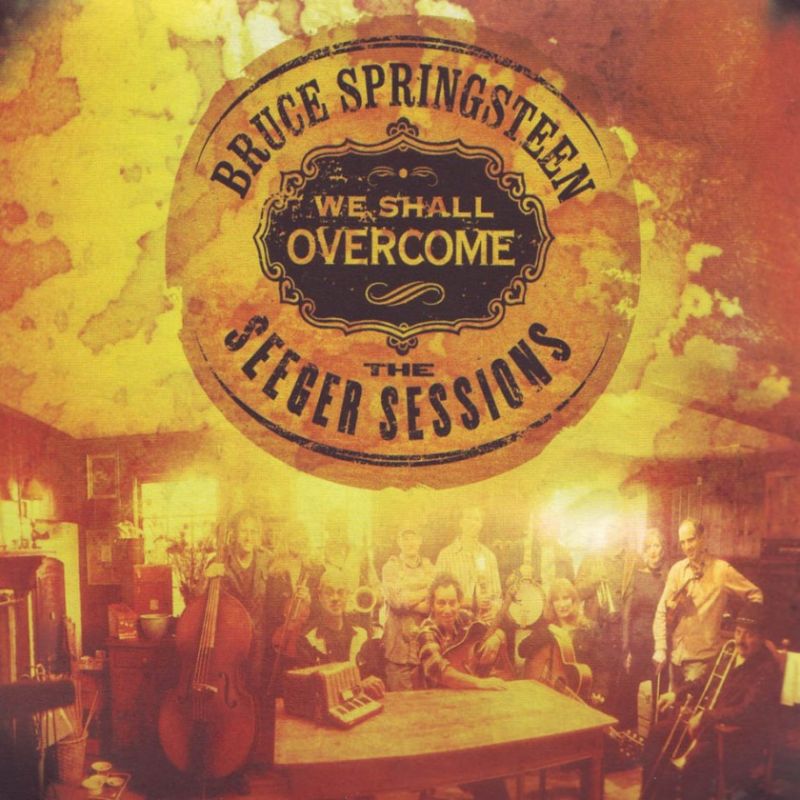
We Shall Overcome: The Seeger Sessions was released in 2006, it is the fourteenth studio album by Bruce Springsteen.
This is Springsteen’s first and so far only album of non-Springsteen material and has his interpretation of thirteen folk music songs made popular by activist folk musician Pete Seeger.
The record began in 1997, when Springsteen recorded “We Shall Overcome” for the Where Have All the Flowers Gone: the Songs of Pete Seeger tribute album, released the following year. Springsteen had not known much about Seeger given his rock and roll upbringing and orientation, and proceeded to investigate and listen to his music.
Jacob’s Ladder (Official video):
Via Soozie Tyrell, the violinist in the E Street Band, Springsteen hooked up with a group of lesser-known musicians from New Jersey and New York, and they recorded in an informal, large band setting in Springsteen’s New Jersey farm. In addition to Tyrell, previous Springsteen associates The Miami Horns as well as wife Patti Scialfa augmented the proceedings. This group would become The Sessions Band.
Bruce Springsteen – The Seeger Sessions Live, a video recording of a May 9, 2006 performance in London’s St Luke Old Street church, was filmed by the BBC.
Here is the full broadcast, Bruce Springsteen & The Seeger Sessions Band at St. Lukes , London:
Throughout the album, there are hints that he’s tired with the Ziggy formula, particularly in the disco underpinning of “Candidate” and his cut-and-paste lyrics. However, it’s not enough to make Diamond Dogs a step forward, and without Mick Ronson to lead the band, the rockers are too stiff to make an impact. Ironically, the one exception is one of Bowie’s very best songs — the tight, sexy “Rebel Rebel.”
~Stephen Thomas Erlewine (allmusic.com)
When this came out in 1974, it was roundly dismissed as Ziggy Stardust’s last strangled gasp. In hindsight, Diamond Dogs is marginally more worthwhile; its resigned nihilism inspired interesting gloom and doom from later goth and industrial acts such as Bauhaus and Nine Inch Nails.
~Mark Kemp (rollingstone.com in 2004)
#2 – Diamond Dogs:
Well.. most the critics dismissed (and still – in hindsight – dismisses) this album. I’ve always liked it. Best to play it all through in one sitting…
Wikipedia:
Released
24 April 1974
Recorded
October 1973 – February 1974 at Olympic Studios and Island Studios, London, and Ludolf Studios, Hilversum, Netherlands
Genre
Rock, glam rock
Length
38:25
Label
RCA
Producer
David Bowie
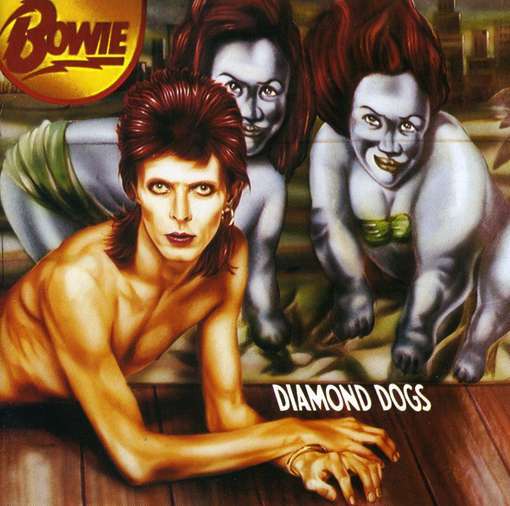
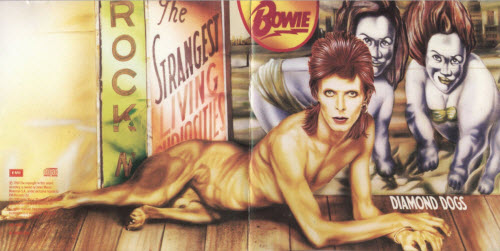
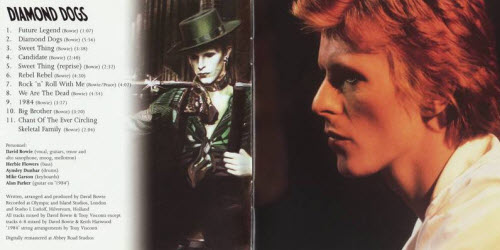
Diamond Dogs is a concept album by David Bowie, originally released in 1974 on RCA Records, his eighth album. Thematically, it was a marriage of the novel Nineteen Eighty-Four by George Orwell and Bowie’s own glam-tinged vision of a post-apocalyptic world. Bowie had wanted to make a theatrical production of Orwell’s book and began writing material after completing sessions for his 1973 album Pin Ups, but the late author’s estate denied the rights. The songs wound up on the second half of Diamond Dogs instead where, as the titles indicated, the Nineteen Eighty-Four theme was prominent.
#6 – Rebel Rebel:
Although Diamond Dogs was the first Bowie album since 1969 to not feature any of the ‘Spiders from Mars’, the backing band made famous by Ziggy Stardust, many of the arrangements were already worked out and played on tour with Mick Ronson prior to the studio recordings, including “1984” and “Rebel Rebel”.
In the studio, however, Herbie Flowers played bass with drums being shared between Aynsley Dunbar and Tony Newman. In a move that surprised some commentators, Bowie himself took on the lead guitar role previously held by Mick Ronson, producing what NME critics Roy Carr and Charles Shaar Murraydescribed as a “scratchy, raucous, semi-amateurish sound that gave the album much of its characteristic flavour”. Diamond Dogs was also a milestone in Bowie’s career as it reunited him with Tony Visconti, who provided string arrangements and helped mix the album at his own Good Earth Studios in London, on a Trident B-range console, brand new from Trident at the time. Visconti would go on to co-produce much of Bowie’s work for the rest of the decade.
#7 – Rock’n Roll With Me:
The record was Bowie’s glam swansong; according to author David Buckley, “In the sort of move which would come to define his career, Bowie jumped the glam-rock ship just in time, before it drifted into a blank parody of itself”. At the time of its release Bowie described Diamond Dogsas “a very political album. My protest … more me than anything I’ve done previously”.
Diamond Dogs’ raw guitar style and visions of urban chaos, scavenging children and nihilistic lovers (“We’ll buy some drugs and watch a band / And jump in the river holding hands”) have been credited with anticipating the punk revolution that would take place in the following years.
Track Listing:
All songs written by David Bowie, except where noted.[14]
“Future Legend” – 1:05
“Diamond Dogs” – 5:56
“Sweet Thing” – 3:39
“Candidate” – 2:40
“Sweet Thing (Reprise)” – 2:31
“Rebel Rebel” – 4:30
“Rock ‘n’ Roll with Me” (lyrics: Bowie; music: Bowie, Warren Peace) – 4:00
“We Are the Dead” – 4:58
“1984” – 3:27
“Big Brother” – 3:21
“Chant of the Ever Circling Skeletal Family” – 2:00
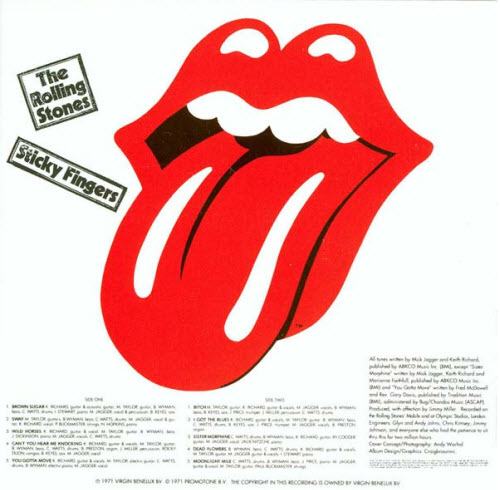
Sticky Fingers was never meant to be the title. It’s just what we called it while we were working on it. Usually though, the working titles stick.
~Keith Richards 1971
While many hold their next album, Exile On Main St., as their zenith, Sticky Fingers, balancing on the knife edge between the 60s and 70s, remains their most coherent statement.
~Chris Jones (bbc.co.uk)
#1 – Brown Sugar:
Wikipedia:
Released
23 April 1971
Recorded
2–4 December 1969, Muscle Shoals Sound Studio, Sheffield, Alabama; 17 February, March – May, 16 June – 27 July, 17–31 October 1970, and January 1971,Olympic Studios, London, UK; except “Sister Morphine”, begun 22–31 March 1969
Genre
Rock
Length
46:25
Language
English
Label
Rolling Stones
Producer
Jimmy Miller
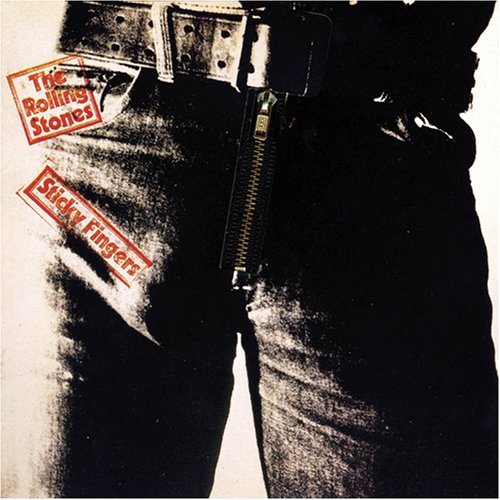
Sticky Fingers is the ninth British and 11th American studio album by English rock band The Rolling Stones, released in April 1971. It is the band’s first album of the 1970s and its first release on the band’s newly formed label, Rolling Stones Records, after having been contracted since 1963 with Decca Records in the UK and London Records in the US. It is also Mick Taylor’s first full-length appearance on a Rolling Stones album, the first Rolling Stones album not to feature any contributions from guitarist and founder Brian Jones and the first one on which Mick Jagger is credited with playing guitar.
The album is often regarded as one of the Stones’ best, containing songs such as the chart-topping “Brown Sugar” and the folk-influenced “Wild Horses”, and achieving triple platinum certification in the US.
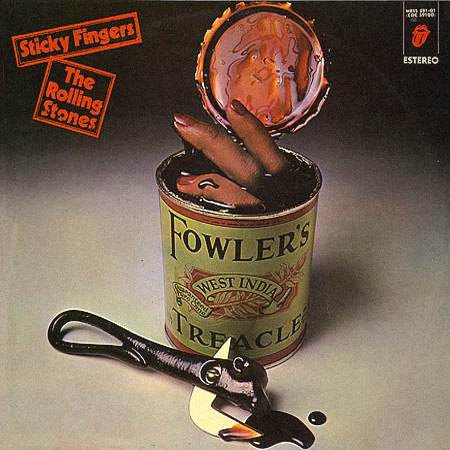
Spanish Cover
#3 – Wild Horses:
During the tour of the States we went to Alabama and played at the Muscle Shoals Studio. That was a fantastic week. We cut some great tracks, which appeared on Sticky Fingers – You Gotta Move, Brown Sugar and Wild Horses – and we did them without Jimmy Miller, which was equally amazing. It worked very well: it’s one of Keith’s things to go in and record while you’re in the middle of a tour and your playing is in good shape. The Muscle Shoals Studio was very special, though – a great studio to work in, a very hip studio, where the drums were on a riser high up in the air, plus you wanted to be there because of all the guys who had worked in the same studio.
~Charlie Watts in 2003
Recording:
Although sessions for Sticky Fingers began in earnest in March 1970, The Rolling Stones had recorded at Muscle Shoals Studios in Alabama in December 1969 and “Sister Morphine”, cut during Let It Bleed’s sessions earlier in March of that year, was held over for this release. Much of the recording for Sticky Fingers was made with The Rolling Stones’ mobile studio unit in Stargroves during the summer and autumn of 1970. Early versions of songs that would appear on Exile on Main St. were also rehearsed during these sessions.
#9 – Dead Flowers:
To my mind the things that Ry (Cooder) plays on have a kind of polish that the Stones generally began to develop around that time. The rough edges came off a bit. Mick Taylor started putting on the polish that became the next period of the Stones out of the raw rock and blues band.
~Jimmy Miller in 1979
In 2003, Sticky Fingers was listed as #63 on Rolling Stone magazine’s 500 Greatest Albums of All Time.
Mick Jagger – lead vocals, acoustic guitar on “Dead Flowers” and “Moonlight Mile”, electric guitar on “Sway”, percussion on “Brown Sugar”
Keith Richards – electric guitar, six and twelve string acoustic guitar, backing vocals
Mick Taylor – electric, acoustic and slide guitar (not present during “Sister Morphine” sessions)
Charlie Watts – drums
Bill Wyman – bass guitar, electric piano on “You Gotta Move”
Additional personnel
Bobby Keys – saxophone
Jim Price – trumpet, piano on “Moonlight Mile”
Ian Stewart – piano on “Brown Sugar” and “Dead Flowers”
Nicky Hopkins – piano on “Sway”, “Can’t You Hear Me Knocking”
Jim Dickinson – piano on “Wild Horses”
Jack Nitzsche – piano on “Sister Morphine”
Ry Cooder – slide guitar on “Sister Morphine”
Billy Preston – organ on “Can’t You Hear Me Knocking” and “I Got the Blues”
Jimmy Miller – percussion on “Can’t You Hear Me Knocking”
Rocky Dijon – congas on “Can’t You Hear Me Knocking”
Paul Buckmaster – string arrangement on “Sway” and “Moonlight Mile”
Engineers – Glyn Johns, Andy Johns, Chris Kimsey, Jimmy Johnson
Cover concept/photography – Andy Warhol
We made (tracks) with just Mick Taylor, which are very good and everyone loves, where Keith wasn’t there for whatever reasons… People don’t know that Keith wasn’t there making it. All the stuff like Moonlight Mile, Sway. These tracks are a bit obscure, but they are liked by people that like the Rolling Stones. It’s me and (Mick Taylor) playing off each other – another feeling completely, because he’s following my vocal lines and then extemporizing on them during the solos.
~Mick Jagger in 1995
These three songs are all taken from one show, it was a triple bill held in the sold out 2,000-seat Ahmanson Theatre, with Bruce Springteen opening for Dr. Hook and The Medicine Show and headliner New Riders of the Purple Sage.
All three videos in great quality both sound and picture, enjoy!
This concert is often confused with the private CBS Sales Convention show (see July 27 for details). However the Ahmanson Theatre show was a normal, public admission event, but incorporating an unusual format. Organized and promoted by CBS as ‘A Week To Remember’, seven consecutive nightly shows, each show featuring three different CBS artists. Bruce and the band flew to L.A. on April 30, stayed at the Hilton hotel, performed on May 1 and returned east on May 3. The above-mentioned setlist represents Bruce’s complete 40 minute performance. The recording of “Wild Billy’s Circus Story” from this show was issued promotionally by CBS on July 7 as part of its Playback EP series. The remainder of the audio from this show is uncirculating, except for the brief snippets of “Spirit In The Night” and “Thundercrack” that accompany its corresponding video snippets.
All seven shows in the Ahmanson series were filmed in color by Arnold Levine Productions on behalf of CBS, whose intention was to have material to show to reps at the CBS Sales Convention in July. This happened, Bruce’s complete performance was shown several times at the Convention, but has never been shown anywhere since. It remains in CBS’s vault. Brief snippets of “Wild Billy’s Circus Story” and “Thundercrack” were used in mid-1974 as part of a promo-only video clip created by CBS to promote the second album. This clip readily circulates and, indeed, was shown in the VH-1 Rockumentary. The frustratingly brief film excerpt of Springsteen performing “Spirit In The Night” on piano that was shown in the 1998 Bruce Springsteen: A Secret History BBC Documentary is from this show. “Tokyo” was preceded by the Ducky Slattery monologue and at the conclusion of “Thundercrack” a giant Garden State Parkway sign descended from the ceiling, the only time this prop was ever utilized (see photo). “Twist And Shout” was the encore. Three songs from this appearance (“Spirit In The Night”, “Wild Billy’s Circus Story” and “Thundercrack”) were officially released as (elaborately restored) bonus footage on the Wings For Wheels documentary DVD in 2005. However, “Thundercrack” is incomplete and cuts at just over ten minutes. An hour of raw footage from this show is now among collectors, featuring multiple versions of the three promotional tracks, each shot from a different camera angle. On this video you can also hear a brief snippet of the introduction to “Does This Bus Stop At 82nd Street?”.